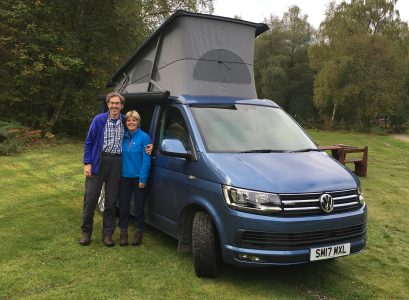
Day 243 Meteora, Greece.

Today has been a busy one. After breakfast, we set off to the nearby town of Kastraki on a mission. On our evening walk last night, we had spotted a studio selling brightly coloured kinetic mobiles. They had intrigued us, and we went back to explore. We ended up having a long chat with the lovely man who made them, and couldn’t resist making a purchase. Yet another piece of clutter for the van, but thankfully packed flat, so taking up very little room.

We then set off up the mountainside to Meteora, to visit some of the amazing monasteries that sit perched on extraordinary pinnacles of rock. By the time we arrived at the first one, it was already busy, and the heat was rising. It was a steep walk up many stone steps to reach the monastery, and at one point, we had to walk through a very narrow tunnel formed in the rock. But it was worth the effort. The views from the top were amazing, looking out over the other weird rock formations, and across to other monasteries. 

The first one we visited had on display the old carpenter’s workshop – which seemed to be mainly involved in making wine barrels, no doubt imbibed by the monks. The old kitchen was also just as it had been centuries before. Howard spent a while absorbing facts in the little museum. He returned mainly with a series of gory stories relating to the religious frescoes on the walls. Many of them seemed to involve burning victims to death (if they didn’t have the correct faith), enveloping them in a stoney tomb whilst still alive (again, if they wouldn’t renounce Christianity), or the ultimate – being decapitated, resulting in sainthood! Religion has a lot to answer for!

At one point in history, there were twenty four working monasteries in operation in this area, but now only six are still active, two of which are inhabited by nuns. In total the monastic population is now only fifty six – fifteen monks between four monasteries, and forty one nuns between the two nunneries. The monks must be rattling around! A definite win for the ladies, it would seem! These days, the enterprising nuns seem to spend most of their time selling small religious trinkets in the gift shops that they operate, and judging from the numbers visiting today, they must do pretty well. Another success for the ladies!

After our long morning, we were starting to expire in the heat, so wound our eye back down to the town of Kastraki for some refreshment. Two unfortunate things happened over lunch. Firstly, the restaurant started paying ‘Zorba the Greek’ – they really do like this tune, as does Howard. Secondly, as we left, Howard forgot to pick up his cork hat.

We didn’t realise that ‘Corky’ was missing until we started to walk up to one of the nunneries in the afternoon. The worried look on Howard’s face was a picture. I really don’t think he enjoyed the nunnery visit – he was too busy fretting over his hat.

I took pity on him, and when we got back to Oscar, before heading off on our other visits, we re-traced our steps the couple of miles down the road to collect his trusty friend. Phew! It was still there. The restauranteur really didn’t have good enough English to understand Howard’s account of having the only cork hat in the whole of Scandinavia and Eastern Europe!

We competed our tour of the monasteries by driving to the very top of the plateau, to look back over this remarkable sight. The geology in this area is truly remarkable, and quite how these monasteries ever got build it quite phenomenal. It was yet again down to Howard’s friend, Alex, that we discovered this amazing UNESCO area. We are delighted that we have seen for ourselves this part of Greece – very different from the coast to which most tourists are drawn to.

We finished off our day with yet another wonderful meal in the campsite taverna. The family who own this site most be sitting on a gold mine. Whilst all the other Greek campsites are winding down for the season, this one is completely full. The large group of Slovenian ‘Big Whiters’ were all eating in the taverna tonight. They sat at a long tressle table, and before they ate, they all stood up, sang the Slovenian National Anthem, and gave a toast. Quite touching, and considerably more melodic than the British one! For once, I had warm feeling towards people in ‘Big Whites’. Perhaps I’m going soft in my old age!!

Day 242 Kato Gatzea, Pelion Peninsula to Meteora, Greece.

Today we set off early from our campsite, and headed back to the mountain village of Makrinista, which we had attempted, but failed, to visit yesterday. Unbeknown to us, the car rally event was still running today, but fortunately we left in good enough time, and the road blocks were not yet operational. Nevertheless, we only just managed to bag a parking space, exacerbated by a large christening party also trying to access the small parking area below the church.

It was well worth our perseverance. It is a truly beautiful little village, build on the steep hillside, with winding cobbled footpaths leading up to the various levels. The village was first populated in the 13th century. It seemed quite extraordinary to us, how these houses had been constructed, clinging limpet-like to the rocks. We walked along the pedestrian lanes to the main square. As yesterday, the square was dominated by large plane trees, forming a large umbrella-like shade across the entire square. We sat on the terrace, looking out on the spectacular view back to Velos, and had our morning coffee. In the corner of the square was a large water fountain, one of over fifty in the village, providing fresh mountain water.

After coffee, we went off to explore the village further, walking up the steep cobbled paths to the church. Today, because there was to be a christening, the door was decked to in balloons, and very well dressed family members were arriving, and all crooning over the babe in it’s christening gown. Many of the small shops were selling honey, apples, preserves and bags of a herbal mixture, used to make a tea-like infusion. 

By the time we left, many Greek visitors were starting to stream into the village. It is clearly a popular weekend excursion, and apparently attracts visitors year-round. We came across the same whistle blowing policeman as we had seen yesterday. I must say, that the Greek police have been a particularly jolly bunch, happily waving us past, perhaps wondering why on earth we were there two days in a row.

We left the Pelion mountains with a very different view of Greece, from the stunning Aegean coastline that we had so far experienced. Stunning little hillside villages, in a very verdant fertile part of the countryside – just wonderful.

We headed back to the motorway, and drove first northwards, then westwards, into the interior of the country. We have come to another amazing place – Meteora. It is known for it’s utterly stunning rock formations, with monasteries perched on top.

The rocky pinnacles were once sediments of an inland sea, and are formed from sedimentary rocks. Over ten million years ago, tectonic movements pushed the rocks upwards, the erosion and weathering caused fissures and cracks to develop. They really are the most extraordinary sight, and one which you can see from many miles away on the approach into Meteora. As we drew closer, it was hard not to gasp at their bizarre and dominating form – smooth towering pinnacles reaching to the sky. We then started to spot the monasteries, perched precariously aloft.

Having pin-pointed our campsite, we drove up the winding road to take a close look. The area was first inhabited in the 11th century by monks, living as hermits in the many caves and fissures. By the 14th century, as the Byzantine empire was waning, and the Turks were having frequent incursions into the area, monks took to this area for refuge, and started to build the monasteries. The inaccessibility of Meteora made it the perfect retreat. Initially, the monasteries were accessed by a series of ropes, removable ladders and pulleys. Today a road leads you upwards into this magical world, and most of the monasteries can be accessed by steep steps or foot bridges. In the intense afternoon heat today, we opted just to survey from afar. Tomorrow, we plan to take a closer look.

Just as well that we weren’t late arriving on our campsite. Within minutes of our arrival, about fifteen ‘Big Whites’ from Slovenia all trooped in together – all friends, and I guess retired empty-nesters on their yearly jaunt. As a result, there is precious room left on the campsite now, and as the evening has gone on, we have tents all around us.

No matter – it is a pleasant enough site, and the in-house taverna serves excellent Greek food. The only slight problem, is that they also play ‘Zorba the Greek’ music while you eat. I don’t really need to say anymore – you can guess what one Dr. Marriage is up to tonight?!!!

Day 241 Kato Gatzea, Pelion Peninsula, Greece.

Today we set aside to explore the mountain villages of the Pelion Peninsula. In Greek mythology, Pelion was the summer home to twelve Gods of Mount Olympus. My Lonely Planet also tells me that in Greek mythology, Pelion was home to Centaurs – half men / half horse, creatures who roamed the peninsula drinking wine, deflowering virgins (quote!), and generally ripping up the countryside.

In reality, the Pelion Peninsula is divine. It sits between the Pagasitikos Gulf to the west, with it’s gently shelving beaches, and the Aegean to the east, where the steep wooded mountains plunge into the rocky coastline. The interior of the peninsula is mountainous, dotted with little villages, literally clinging on to the mountainsides, and reached by narrow tortuous winding roads, with more hairpin bends than you can imagine. Despite it’s mountainous nature, the peninsula is nonetheless very fertile, with terraced orchards of apples, and an abundance of chestnut trees.

We set off this morning in high spirits, and our itinerary marked out. We first drove to Volos, and then headed up the steep precipitous roads towards Makriniska. However, half way along our route, the road was closed off by two policemen. They informed us that there was to be a motor rally later in the day, and so diverted us along another equally winding road. Another five kilometres or so along this route, we were stopped yet again, by an equally charming Greek policeman. He ordered us to park up by a bollard, and to wait until he gave us the signal to move.

We waited five or so minutes, by which time, we had a large cue of vehicles backed up behind us. The policeman came back to talk to us. ‘Move when I blow my whistle’, he instructed.

A couple of minutes later, when the queue of cars had finished coming from the opposite direction, we heard three loud toots on his whistle, and off we went. Howard reported it feeling quite strange, being the forward flank of a convoy of cars negotiating a series of about twenty hairpin bends. Fortunately, Oscar excelled himself, and we got to the village without incident. However, on arrival, we were met by policeman number three, who told us that the parking in the village was full, because of the car rally, and we would have to park further down the hill.

We drove for about three quarters of a mile, with no sign of a parking place big enough for Oscar, and in the end just gave up, and drove on to the next village.

We were disappointed, since it is reputedly one of the prettiest villages, but the thought of a car rally racing past Oscar was not exactly putting us at ease. We decided to maybe try again tomorrow, once all the crowds have up and left.

The next village, Portaria, however, was a gem. The main square was graced with a huge old Plane Tree, which provided plenty of shade for the delightful cafes round about. We sat and had our coffee, and then wandered off to explore. Along the street, there were shops selling jars of the famous Pelion apples, as well as honey and preserves. Away from the main street, were a series of steep cobbled paths – the Centaur paths. We followed one up above the village, where the views were splendid, past little mountain streams, and tiny stone cottages, which seemed to be defying gravity clinging on to the slopes.

After our exercise, we returned to Oscar, and decided to head across the mountains to the other coast, so avoiding the car rally. The drive over the mountains was hair-raising, to say the least. I lost count of how many sharp hair-pins we did, but it seemed like hundreds. As we drove, we passed by copious apple orchards, heavily laden with bright red apples, we could see that the harvest was imminent. At intervals along the road, coloured crates had been laid out to collect the produce, and we passed a couple of trucks laden with full crates, as we drove. Pelion is the apple capital of Greece, and clearly this verdant lush landscape is ideally suited for their cultivation. As well as apple orchards, we passed loads of chestnut trees, again in fruit, and many rows of bee-hives. Honey is abundant here, and many stalls beside the road were selling it

We stopped at a village called Zagora. It had a fine church, and beside the church, in a little square, were a couple of cafes. We stopped for a drink and a snack, before winding our way back to the campsite. The views on the way home were spectacular, looking back over the steep hillside villages, and out across the Aegean. Driving back, we noticed many roadside tavernas – clearly this is a popular place with visitors in the summer. We also passed a sign for a ski centre, and in the distance, we could just make out what appeared to be ski lifts.

Back at the campsite, we enjoyed a lovely meal at the taverna by the beach, having reserved a table by the shore the night before.

We have really enjoyed our stay in Pelion. Today was like visiting another world, up in the mountains. Sadly though, no centaurs in evidence today, apart from a statue, and a piece of street art. It is a part of Greece that we never would have discovered, had it not been for a tip from Howard’s Greek friend – so thank you Alex!

Tomorrow we head for the interior of northern Greece, to discover another part of the country that we had never previously heard of. Watch this space!

Day 240 Galini Neo Marmaris, Sithonian Peninsula to Kato Gatzea, Pelion Peninsula, Greece.

Today we dragged ourselves away from our gorgeous campsite on the Sithonian Peninsula, bidding farewell to George in the taverna, and the lovely owner, who made us promise we would return someday. Frankly, it would have been very easy to have stayed another week, but seeing as we had drunk all the bottles of nice white wine (they only had two!), we decided it was time we moved on. On this entire trip, there are probably only a handful of places that we would contemplate returning to, and this is definitely one of them. All the better for being off the main tourist drag, and only possibly to visit by staying in the campsite. It is hard, sometimes, to vocalise the advantages of camping, over staying in a luxury hotel – but this is a prime example. You could never replicate this experience by staying in a hotel. To be able to sleep that close to the beach, with the waves lapping on the shore, is utterly priceless, and undoubtedly better for being out of peak season.

We had a long drive ahead of us, moving first westwards past Thessaloniki, and then southwards towards the Pelion Peninsula, recommended to us by one of Howard’s Greek work colleagues. As we drove southwards on the motorway, we noticed a towering range of mountains to our right, with one tall peak in particular. It was only when I checked the map that I realised that it was Mount Olympus – quite impressive indeed.

After a couple of stops for shopping and refreshments, it was after five that we arrived at our next campsite, another family run affair. The female owner was very pleasant, and walked us around the various available pitches. It was hard, however, not to compare with what we had just left. Our pitch is fine, with glimpses of the sea, but the beach bears no comparison to Sithonia. We are here though, not for the beach, but to visit the local mountain villages, which is our plan for tomorrow. Howard has become very excited, since this peninsula was home to the Centaurs, half men, half horse in Greek mythology. Having scoffed at him, and told him not to be ridiculous – he would never see a Centaur – he shrieked with delight, as the car in front of us had a Centaur spare wheel cover! Easily pleased, I guess!

After a quick lap along the beach, we settled for supper in the beach-side taverna. We watched another lovely Greek sunset, and planned our day ahead. 

A paucity of photos today, as we have been in the van most of the day.

Day 239 Galini Neo Marmaris, Sithonia Peninsula, Greece.

Well, contrary to our plans, we did indeed end up spending another day at this gorgeous campsite! In the end, we just couldn’t drag ourselves away from our gorgeous little private beach and prime pitch, especially since by last night, there were only two camper vans left at our end of the site, ourselves and the wonderfully quiet Austrian couple.

So it was another day doing very little really. Howard had his early morning run, and reported that in the early morning, the fragrant smell from the Oleander by the side of the road was divine. As yesterday, he arrived back in a sweaty heap, and immediately threw himself into the sea to cool down. After breakfast, we spent most of the morning trying to sort out the ‘dongle’ account. It has taken most of our trip to get it up and running. It was only when Oliver came out to meet us in Arctic Norway, armed with a new sim card, that we eventually got it to work. The dongle itself had followed us around Europe – first posted to Cordoba in Spain, then Sicily, then Croatia. The original sim, however, didn’t fit in the device, so Thomas was supposed to bring a new sim device out to Iceland. It never reached him, and so eventually, Oliver delivered it in Norway. Having got it operational, we had failed to realise that it didn’t cut out when we had overspent our data allowance, so we were confronted with quite a hefty bill from O2. Transferring the photos from my iPhone to the blog has proved very data heavy, but no matter – we have at last got it sorted.

So after a morning listening to very hip rap music on O2s ‘please hold’ answerphone, we decided that we needed a treat.

We set off in the midday sun to the next village, on foot. We had spotted a taverna on our drive into the campsite, that looked rather good. We were not disappointed. After a one and a half kilometre walk, we found ourselves at a little harbour, sitting in the shade, in a lovely little restaurant. All the other tables seemed to be filled with locals. Stupidly, we over-ordered. As well as tzatziki, cheese croquettes, fried zucchini and a tomato and cucumber salad, Howard also ordered the ‘house’ salad. To say that we were overfed on tomatoes, cucumbers and lettuce would be a complete understatement! Ten people could have eaten what we were presented with! It was all very tasty, but way too much. 

We staggered back to our campsite, bloated from our overdose of fibre. To work off the excess food, we took to the water. By now, our lilo skills have improved considerably, and we spent a pleasant hour or two, splashing around in the lovely warm water.

I cannot describe in words how lovely this place is. At night, all we can hear is the rhythmic sound of waves, gently splashing on the shore, and the occasional cicada. The beach is small, but beautiful, and essentially, we have it all to ourselves, apart from the Austrians, and a German couple who arrived this morning. All the other campers use a larger beach around the headland – I’m not sure they even realise this beach is here! If we had to pick our ideal campsite, this would probably come pretty close. It is an experience you could only get from camping here. No-one else is allowed on the site. 

The most special thing about this place are the sunsets. Every night, we have watched the blazing yellow sun slowly turn to orange, then red, as it slowly sets over the little island offshore. Last night, Howard celebrated the sunset with yet another rendition of his ‘Zorba the Greek’ dance. The locals looked on quizzically! The people who work here don’t realise how lucky they are. Sure, they have been through some difficult financial times, but to live and work in this environment, to me, is priceless.

We will leave here with very fond memories. All the staff are delightful, from the cleaning ladies, the gardener, the taverna waiter to the campsite owner. It has reinforced to us, that on this trip, it is the people that you meet that make the difference from a good stay to an excellent stay – and this has been one of the best. Hopefully, the rest of Greece can match it.

Day 238 Galini Neo Marmaris, Sithonia Peninsula, Greece.

Today we have had a very chilled day. The temperature has dropped a little, and there is some cloud in the sky. For the first time in days, it was cool enough first thing this morning for Howard to have his morning run. On returning to the campsite, he jumped into the sea, only to find that he had company. A shoal of jellyfish, some quite large, were swimming close to the shoreline. Needless to say, he didn’t hang around to see if they were dangerous.

A little later, talking to the campsite owner, he confirmed that they would give you a moderate sting. By 11am, many had washed up onto the shoreline, and the campsite gardener came around, and collected them up in his wheelbarrow. I waited a good hour or so, before I ventured in to swim, and then only after I had surveyed the water thoroughly.

Other than that, we have had a pretty lazy day. Our highlight was the purchase of a blow-up lilo. We saw it for sale in the camp shop. When the elderly Greek man at the till asked how we would inflate it – Howard pointed to me, and said, ‘My wife can blow it up!’. The shopkeeper was having none of this, and scuttled off to blow it up with his compressor.

After lunch in the taverna, we spent the rest of the afternoon splashing around in the warm water with the lilo. Although the purchase had been my idea (largely because I thought I could avoid the jellyfish, by floating on it), as ever, Howard mastered it much better than me. He was able to propel himself around, and watch the fish swimming around about him. The water here is so clear, that you can see all the marine life below you. 

After our exertions in the water, we showered ourselves down, and celebrated our lazy day with a Caorunn. The words of one of my Dad’s favourite songs came to mind, 

‘I’m busy doing nothing, nothing the whole day through,

Trying to find lots of things not to do. 

I’m busy going nowhere, isn’t it just a crime? 

I’d like to be unhappy but, I haven’t just got the time!”.

We finished off the day with a return visit to the taverna, for a salad and grilled aubergine. Very tasty. We had planned originally to leave tomorrow, but have decided to stay one more day. I’m sure by then, our boredom levels will be rising. There’s only so long you can spend camping by a beach in the Aegean, isn’t there?!!

Day 237 Elia, Sithonia to Galini Neo Marmaris, Sithonian Peninsula, Greece.

OK – I’m going to stick my neck out here. The is probably one of the loveliest places we have visited in our eight months on the road! We have moved from the campsite where we spent last night, to just twenty kilometres or so further down the peninsula. The situation of our last campsite was great, but there were a couple of things that niggled us. Our pitch was looking out over the beautiful turquoise Aegean – but we had to look through a wire fence – such that I was starting to feel like a caged animal. The other thing that bugged us was the shower system. It involved putting keys in a machine, at a cost (cold showers were free, hot ones not), and then being timed. Frankly, for 21 euros a night, I think they could have thrown in a shower, and not made us sit behind a wired fence!

So we moved on southwards. En route, we stopped off at the coastal port of Neo Marmaris, a pleasant little harbour town, with cafes and a few shops. We purchased our Greek flag, some more suntan lotion (it is still very hot here), and then found a gorgeous little cafe by the harbour, with blue gingham tablecloths, and enjoyed our morning coffee. For once, the heat drove me to a Frappe, which was excellent. Howard stuck to the thick gloopy Greek coffee. We watched a local down by the harbour snorkelling amongst the rocks. Suddenly, he reached down, and pulled out an enormous octopus from under a rock. His wife, stood at the shoreline, egged him on, as he produced what was presumably their supper for tonight!

Then we continued on to our campsite, passing through lush pine forests in the hills above the coast. We passed by a string of brightly coloured beehives – a common sight in these parts, since honey is a key ingredient in the Greek’s favourite sweet pastry Baklava, made from layers of filo pastry interspersed with nuts, and held together with honey. Our campsite, as well as being advertised on our ACSI app, I also noticed that it had an entry in ‘Cool Camping in Europe’. It is indeed a very ‘cool’ place. It is a small family run affair. The owner led us down to the beach and let us select a pitch. We selected one with shade, but a little bit of sun, and a gorgeous view of the sea. There are only two other camper vans in our section, the rest are up higher in the olive grove. Consequently, we have this section of the campsite virtually to ourselves. Our section has a lovely shelving sandy beach. The olive grove campers also have their own private beach, but there are more of them. The best thing about our pitch is that it is maybe twenty yards from the campsite taverna – which is splendid. 

This afternoon, for the first time in years, Howard and I went swimming in the sea. It was like taking a warm bath. The water was crystal clear, and we could see fishes swimming underneath us. Tonight we had our supper at the taverna. We enjoyed a very nice bottle of local white wine (yes – a whole bottle!!), and some very tasty Greek food. As we ate, we watched the sun slowly set below the horizon.

Originally, we had planned to stay for a night – but it is too nice to move on that quickly, so we will definitely stay at least another day.

Howard has been engrossed in conversation with the campsite owner. Contrary to my comments yesterday, about Greece being in a good place – he feels the opposite. He told us about the high taxes, corruption, excessive youth unemployment and real problems with the migrants from Syria and sub-Saharan Africa. He told us that many of the talented youth are travelling to work in other parts of Europe because they cannot get jobs in their own country, and was concerned that there was no money to re-invest in the infrastructure. We listened to his concerns, and understood what a difficult time the Greeks have been going through financially. However, for us, as tourists, it still feels welcoming. I think one of Greece’s biggest natural resources is it’s beautiful coastline and idyllic islands, and unique culture. I suspect that it will take Greece a few more years to get back on it’s feet again, but I have little doubt that they will succeed. 

Tonight, we are both feeling very relaxed. I cannot fathom why this part of Greece is not more popular with tourists, but selfishly, I am delighted that they haven’t discovered it yet. This campsite must be one of the nicest we have stayed on in eight months. Greece has not lost it’s magic after all these years!

Day 236 Xanthi, Thrace to Sithonian Peninsula, Macedonia, Greece.

Last night I had an interesting experience in the washrooms. Despite being in a lovely situation by the beach, the bathroom facilities in our campsite were a tad dated. The ladies’ wash block had four squat toilets (French style), and showers with malfunctioning heads. Howard reported that the wash block that he was using (assumed to be the men’s, but with no sign to say so), had three squat toilets, and one sit down toilet, albeit without a lock. He suggested I try his facility.

So last thing before settling down for the night, I venture along to the wash blocks with Howard. No-one else is around, so I decide to join Howard. All is going well. I use the only sit down toilet on site, and then go across to the sinks to wash my hands. What Howard had failed to inform me, was this his wash block had a resident population of eight little green frogs! They gave me the fright of my life, as one hopped to of the washbasin. The joys of camping!

This morning we set off eastwards along the Aegean coastline. First stop was the town of Kavala, with a busy port and ancient Ottoman aqueduct. We were only planning on stopping for a late coffee, but the pretty harbour where we found ourselves looked so appealing, that we sat down on the restaurant terrace and ordered a light lunch. Howard went for Greek salad, which seemed the appropriate thing to eat, listening to the local music that was being played. Thankfully, we had no more renditions of Greek dancing, although I’m sure it is only a matter of time!

I must say, that so far, there is no evidence of the harsh austerity measures that we had been hearing about back home. Greece is up and running, and open for business. Everywhere appears clean, the roads are fine, and above all, there seems to be a sense of civic pride about the place. The people have been universally friendly and welcoming. Clearly, as a country, they have been through a difficult period, but as a visitor, it seems no different from the Greece we recall all those years ago.

Continuing on, we couldn’t help but notice lots of little road-side shrines, many in the form of model churches, beautifully painted. I was intrigued as to what they were, and looked it up. They are called Kandylakia, and are a religious custom that has been going for generations. When someone dies, or indeed is saved, the family will often erect a shrine. But not only that, sometimes they are sited, for example, in olive groves, as a kind of thanksgiving for the harvest, or at the top of mountainsides, as a gesture of thankfulness. Many contain religious pictures or artefacts. I stopped to photograph one, and inside was a small jar of honey, perhaps as a gift for a productive yield – I don’t really know?

As we carried on eastwards, we are now very much back in the land of olive groves, all beautifully kept and tended. We headed towards the Halkidiki Peninsula, with it’s three tendrils extending down into the Aegean. We are staying the middle of the three, the Sithonian Peninsula. I was astonished to discover that the most Easterly of the peninsulas, Athos Peninsula, is owned largely by the Mount Athos Monastic community, in existence for over a thousand years. It is accessed by boat, but wait for this – only males are allowed to visit, and only then by booking ahead about six months in advance. Athos contains twenty working monasteries, and is formally Greek, although ecclesiastically it is under the Orthodox Patriarchate of Constantinople (Istanbul). It is a World Heritage site, and much of it is a nature reserve. However, it has a border, and no women are allowed to enter – in the 21st century!! To say I am a little peeved, is an understatement!

Our first sight of the Sithonian Peninsular is positive. The coastline is mainly rocky, but there are beautiful little sandy coves, with the most stunningly turquoise waters. Our campsite seems fine. No frogs, so far!

We walked down to the shoreline, and sat on the rocks to watch the sunset, Howard with a beer in hand. It has been a little cooler today, and there is a slight sea breeze on our pitch. Tomorrow, we may head a little further down the peninsula – it depends which way the wind is blowing.

For the first time since Croatia, it feels like we are actually on holiday here, rather than just continually travelling. So we may stay longer – but only if we can tolerate the temperatures!

Day 235 Alexandroupoli to Xanthi, Thrace, Greece.

Boy – Greece is hot!! Last night at 10pm our van was recording 37.5 degrees. We had every window and vent open, and the USB fan was in overdrive. I never thought I would enjoy a cold shower at 11pm at night – but I did. It was way too hot to have the duvet on, so we just lay on the sheets and expired. 

This morning seemed a little cooler first thing, and Howard was stood outside Oscar practising his ‘Zorba the Greek’ moves, but by 11am, the temperatures had soared again. We decided to head up into the mountains, where we thought it might be cooler. First we stopped off in a lovely little town called Komotini. Komotini is quite distinct from other towns in Thrace, characterised by it’s multicultural population, being home to both Turks and Muslims. It has a number of tall minarets, and many of the shops sell the sugary Soutzouk Loukoum, Turkish delight based pastries. We stopped for a look around, walking past the old and new mosques, the clock tower, and a tall granite memorial with a large vertical knife engraved on it. We stopped in the park under the shade of some trees, and enjoyed a very good coffee – the town is a university town, and famed for it’s excellent coffee shops. It had a pleasant feel about the place – generally well kept and vibrant. Not a sign of another tourist – more workaday – but we left with a really good feel about the place.

Next we headed to a town called Xanthi, a little further west. From there, we headed north into the mountains, back towards the Bulgarian border. We were visiting the fascinating Pomokohoria, or Pomak Villages – far from the tourist track, and described in one review I read as the ‘land the world forgot’. The villages are tucked up in the Rhodopi Mountains bordering Bulgaria, and are inhabited by Muslims speaking Greek, Bulgarian and Turkish. In Greece, they are classified as Greek Muslims, during the Cold War the area was off limits, and tourists here are rare. It sounded just our sort of place!

The drive up into the mountains was exceptionally scenic, but very steep and tortuous. En route, we started to pass fields of a crop that we couldn’t immediately identify with. Then we realised that they were fields of what looked like Nicotania plants, with most of their leaves removed. We were indeed correct – for this is a prime tobacco growing area, and not before long, we were passing fields, covered with polythene, drying harvested tobacco leaves. 

We headed to the village of Echinos. En route, we passed through a couple of small villages, each with sparkling minarets and lively roadside bars. As we approached Echinos, we crossed over the bridge across the gorge, and spied the three minarets dominating the skyline, along with a Greek Orthodox `Church, painted a stunning white and blue. Stupidly, we had programmed Boris for the centre of town. Big mistake! I did suggest to Howard that we park on the outskirts, but he insisted on driving on through the town. Town is a bit of an overstatement! The streets became narrower and narrower. We were immediately the star attraction. People stood at the side of the road, ogling at this strange vehicle trying to negotiate the ever smaller alleyways. Locals had to move their motor scooters off the road to allow us to pass. A kindly man asked us if we were lost. We said ‘No – we have just come to see your town’. He looked puzzled!

Eventually, we found somewhere to park. We set off on foot to explore. It was an amazing place. A labyrinth of narrow cobbled streets and alleyways. Unlike the rest of Greece, the stores were open, mainly selling fresh fruit and vegetables. We bought some nectarines, really in the hope that people would stop staring at us. The temperature on the neon sign registered 36 degrees at 5pm. Muslim women walked up the street in ornate embroidered headgear. I was eager to take a photo, but I got the sense that it would be frowned upon, so just smiled, and said ‘Hello’. It felt like we were visiting a place from the past. The locals were as interested in us, as we were in them. A couple of the local lads on scooters passed us by several times on our walk, like they were checking us out. But at no time did we feel threatened. It was just out of the ordinary for visitors to come here.

Lap of the village completed, we headed back down the valley, past the tobacco crops, and back into Xanthi. We stopped briefly to take a photo of the church, which seemed to have a wedding in progress. Outside there were tables of drinks, with blue balloons and bunting.

We didn’t linger. We headed on to our campsite for the night. Our campsite is on the coast. When we arrived, there was no-one in reception. Eventually, Howard found someone in the beach bar opposite, who came to check us in, with a towel wrapped around her bathing costume. Howard apologised for interrupting her cocktail!

Once set up, we took a quick stroll on the beach – very sandy and very hot. We took the view that if you can’t beat them, join them. So we sat in the beach bar, and enjoyed a cool drink, watching the sun go down.

It is now 10pm at night. We have just finished eating supper outside the van. The cicadas are noisy, and I am still sweating. It has been beautiful evening, and we would love to stay. However, it is just too hot for us to spend a day here doing nothing. Clearly, all the other campers here are beach addicts. The sea is warm, and the beach incredibly shallow. Howard and I would be bored stiff in less than five minutes, if we stayed. We reflected on what we did all those years ago, whilst back-packing. ‘I think we read lots of books’, Howard replied, ‘And swam, and wrote postcards’.

Clearly our heat tolerance must have been better in those days. Tomorrow we will head west, and luxuriate in Oscar’s air-conditioning! We have even contemplated hanging out by the freezer compartments in supermarkets. I think we are too accustomed to the temperatures in Scotland!!

Day 234 Batak, Bulgaria to Alexandroupoli, Greece.

We awoke to a beautiful still morning on Lake Batak. The light on the water was magnificent, and the campsite was quiet and serene. We packed up the van, and went to thank the owner for his hospitality. On a trip like this, a friendly face makes so much difference to your stay, and certainly the owner of this lovely rustic site was the perfect host. The day we had arrived, I had overheard him come and speak to an elderly French couple with a small caravan pitched on the terrace below us. He had enquired what time they were leaving the next morning, and offered to come on site an hour early to help them turn the caravan and hitch it to their car. As we left, he offered us his telephone number, and said that if we had any problems on our onward journey through Bulgaria, we should phone him, and he would translate for us, since fewer people here speak English! I told him that his was one of the nicest sites we had stayed at on our eight month journey. As we started to drive off, he ran and tapped on the window, and gave us a booklet and map of interesting places in Bulgaria as a gift. Little gestures, like this, can completely affect how you picture a place. As a result, we will look back on Bulgaria with fondness, and hopefully blank out the terrible roads and dilapidated buildings.

Certainly, on the first part of our drive this morning, the roads didn’t improve. We followed a sign to Lidl  in a small town to pick up supplies. The approach road was so pot-holed, that it was no surprise that no-one else was in the car park. A little later, we came across a first – a major road with cobbles! Natasha went into overdrive, and recorded ten ‘incidents’ in the space of a hundred yards – she records on the dashcam when we are in a collision!

Our destination today is Greece. We have a long drive, hence I am starting the blog en route. I am actually very excited about returning to Greece. As I mentioned yesterday, it is forty years since either of us have been here.

When we came in 1978 I had just completed my first year of medical school, and Howard had just resigned his job at Wellcome, in preparation for starting his university career. We were young and in love, and back-packing around the Greek Islands was the thing young people did in those days. I remember distinctly shopping in Southampton High Street for a rucksack, with Howard’s parents in tow, who had come to visit before we left. The deal had been that if I paid for the travel (from my student grant!), then Howard would pay for everything else. How little has changed!! Consequently, I had found a £52 return coach trip for the both of us, from an advert in the Sunday Times. ‘Alekos Tours’ – I remember it well! I will never forget my father’s face, as he waved us off on that coach from a London pavement. He shook Howard’s hand and said, ‘Look after my little girl’. He looked totally horrified. The coach was old. It was overbooked. The last person got a seat in Geneva after they threw an poor woman off the coach for having an epileptic fit. The two Greek coach drivers were appalling. They switched driving whilst still going along the motorway, with one sliding into the driver’s seat underneath the other one, who had half stood up. The then ‘off duty’ coach driver would drink half a bottle of Greek brandy, Metaxa, whilst dancing in the aisle to ‘Zorba the Greek’, with any unseated passengers. They would then lie down in the aisle and go to sleep, only to awake a few hours later, slurp a black coffee from a flask, and take over the driving again. It was supposed to be a three day non-stop coach trip to Athens. But when we arrived in Milan in the early hours of the morning, the drivers met up with two Italian women friends of theirs. They threw everyone off the coach at Milan Station, so that they could ‘take a room’. Consequently, all the passengers (who couldn’t afford a room), spent a very uncomfortable night on the benches of Milan Station. The following day, as we drove down through the still communist Yugoslavia, a fellow passenger tried to persuade Howard and several of the other passengers to smuggle some recording equipment through the border – reel to reel tapes mostly. All was going well until the Yugoslav Police jumped on the coach at the border and took everyone’s passports. At this point, Howard and the others bottled out, and gave back the stash. I do think it was innocent enough, the poor guy was trying to set up a recording studio, but we weren’t prepared to risk it. After the border guards had confiscated the music tapes that they wanted to keep, and a suitable bribe had been paid, we were allowed across the border.

When we eventually arrived in Greece, we had as ball. We spent eight weeks ferry-hopping down through the islands. We did stuff that I would be appalled if my children did. We slept on beaches, we slept one night on a taverna roof sharing one sleeping bag at the head of a gorge, and we hitch-hiked lifts on the back of pick-up trucks. When I think of it now, it seems a lifetime away. In all the time away, I think we phoned home twice – long before the days of mobile phones. My parents must have been worried sick! Although, in fairness, they had let us travel overland to Turkey in the back of an old converted Commer Butcher’s truck two years previously with eighteen others from the London Union of Youth Clubs!! Maybe this year-long trip around Europe in a camper van was always just destined to happen!

Needless to say, we arrived home in one piece, if a little slimmer – and the rest is history. So consequently, we have very fond memories of Greece. The part we intend to visit is one that we have not been to before, the northern Aegean mainland coast, crossing over to the Ionian coast, before catching a ferry back to northern Italy. We would have loved to have visited Turkey, as well, but insurance and political factors make that impossible. That would have been a real trip down Memory Lane!

 A few hours later, and we have just landed in Greece. The drive here was slow and tortuous, first along a heavily wooded gorge in the mountains, and then into flatter terrain. Early on, we stopped to take a photo of a church, with a large stork’s next aloft. Later, we drove across a roundabout with a large stork, stood on one leg, observing the traffic. The border crossing was relatively straight forward – in two parts. The Bulgarian side were most concerned to check that everyone leaving had a vignette – it seemed more sensible to us to utilise this manpower and booth space at the incoming border – since we there was nowhere to buy one at the border entering Bulgaria, and we had to head out and track one down the next morning. The Greek side just waved us through happily. It immediately felt hotter. The buildings changed dramatically, to white-washed buildings with low sloping roofs with terracotta tiles. We also started to spy the odd church in the distance on top of a hill.

We have come to an area of Greece called Thrace. Apparently it is the least visited, and is very close to the border with Turkey in the east and Bulgaria in the north. Our campsite is by the sea, but we have opted for a pitch in the shade of the trees, away from the beach and it’s pesky sand. Have I said before, that Howard doesn’t like sand!!

We have just returned from the beach having had a quick walk. I had completely forgotten how magnificent Greek sunsets are – unchanged after forty years!