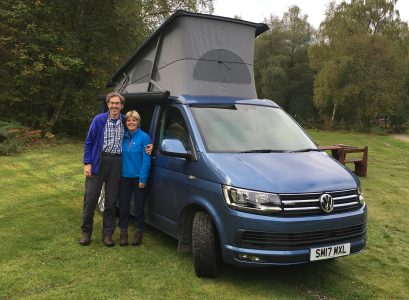
Day 134 Stadarskali to Stykkishholmer, Snaefellsnes Peninsula, West Iceland.

Today was a bit of an adventure. Howard’s shoulder was sore, so I was designated driver for the day. It fell to Howard, therefore, to plan the route and map read. We were heading to the north coast of the Snaefellsnes Peninsula, which was highly rated for it’s astounding scenery. 

After breakfast in our staff-less hotel, (clearly the breakfast fairy had been in during the night, and laid out the buffet breakfast), we thanked and bade farewell to no-one, left our key as instructed, and were on our way.

Within minutes of leaving, Howard had me on a gravel road. He had picked the ‘scenic route’ (quote!). We have encountered gravel roads before, for just a few kilometres, but this route beat the biscuit. At an estimate, I drove about seventy kilometres along the bumpiest, pot-holed, uneven road we had encountered to date. It shook our bones, despite me driving as slow as possible. Local cars and trucks careered past us, at break-neck speed, blowing up tons of dust and gravel in their wake. Safe to say, I was not a happy bunny – that is, until the scenery suddenly became sublime. After that, the surface of the road didn’t seem to matter. Every hundred yards or so, we stopped to take in the amazing vistas before us. Occasionally we stopped and got out of the van, but mostly the road was too narrow to stop unless there was no other traffic in sight. The drive took us the best part of four hours, and at the end, I felt utterly shaken – but was really pleased that we had seen this amazing part of Iceland for ourselves. Most people would just shoot down Route 1, and miss out on this treat completely.

We passed a series of nine Cairns, dating from the first inhabitants of Iceland back in 874. Icelandic Sagas refer to these structures, which are the source of many legends.

When we arrived in Stykkisholmer, the instructions for our B&B were to pick up the key at the local hotel (owned by the same person, we understand). When we presented ourselves at the desk, we were told we had a complimentary upgrade and would have a room in the hotel instead. Our said room is tiny (or snug, as an Estate Agent would say), but pleasantly decorated, and right by the harbour. I suspect they had double booked at the guest house, but no matter – it will definitely be warmer than the van. Despite a little bit of sunshine today, the temperatures here are truly Baltic – not what we had expected at the end of May. Also, staying at the hotel has the added advantage of having WiFi coverage – we have been completely off grid for the past two days, with only sporadic poor 3G coverage throughout the North West of the island.

Stykkisholmer is a pleasant working fishing harbour. This afternoon we took a walk around, and watched the fish being landed off the boats. The harbour crane hoisted crate after crate of huge ugly Lumpfish onto the quayside, and quickly covered them in ice. The female lumpfish are apparently prized for their roe, which is used to make caviar. 

This evening, we ate at the seafood restaurant on the harbour. The fish was delicious, and clearly very fresh – only travelling the few yards to the restaurant kitchen.

Our plans for the next few days are in flux. We had hoped to catch the ferry across to the West Fjords, but the forecast is making that increasingly less likely. Tomorrow we will head further down the peninsula, and then just watch the weather. 

Hopefully in the next couple of days we can get back in the van, but only if the cold and wind abate. Accommodation costs here are eye-watering, even for basic B & Bs. Two coffees and a cake are usually about £10, and a main course about £25, so we are fortunate to have cooking facilities in Oscar.

In all likelihood, we will be off grid again, wherever we end up. In the meantime, after reading yesterday’s blog post (which I couldn’t send until now), Howard has started giving me about five miles notice of any turn off  in the road, and has stopped fidgeting  – so if nothing else, it served a useful purpose!! Result.

Days 132 -133 Akureyri to Stadarskali, North West Iceland.

We have made our way along the remote northern and north west coast of Iceland. After leaving Akureyri, the scenery became even more spectacular, with mile upon mile of dramatic vistas of snowy mountains. It was hard not to pull over every few hundred yards to take photos, but Route 1, the main Icelandic ring road is not really conducive to stopping, except in designated lay-bys or viewpoint. A few times, if there was no traffic in sight, we did pull in briefly, or take photos through the car windows, but often we were unable to stop, and so will have to remember these wonderful scenes in our minds. Indeed, it is one of Howard’s favourite phrases, when I urge him to stop yet again – ‘Just remember it in your mind’, he will say. But any photographer reading this will know, the there is nothing more totally frustrating that to see a brilliant shot, than to just go sailing past. I have also been doing quite a bit more of the driving, to give Howard a bit of a break at times on a long drive, which makes it all the more difficult to capture the scenery. Howard makes a bad co-driver. He fidgets in his seat, he fiddles with knobs, he crumples the map, and he gives approximately 5 seconds notice when I need to turn off. If I say so myself – I am a much better map reader (all down to the Girl Guides!), I give precise and much better instructions to the driver, and I don’t constantly fiddle. So I think we know where our strengths lie – since I am the first to admit, that he is a much better and more confident driver than me. Maybe by the end of the trip, his co-driver skills will improve – but at times, it is reminiscent of driving with my middle child!

Back to the trip. The guide book informed us that there was not much habitation along the north coast, so to fill up with petrol at any opportunity, since garages were few and far between. This proved exactly to be the case, since after filling up in Akureyri as we left, I don’t recall seeing anything along the route for a hundred kilometres or so, and there were certainly no towns at all. The first stretch of the journey west follows Oxnadalur, a narrow 30km long narrow valley through the mountain pass, flanked with stunning peaks and tall rock pinnacles. White water rafting and horse-riding seem to be the main attractions in this area, but we chose to give both of those a miss. Later, the road follows Langidalur, the ‘Long Valley’ west, then northwest, eventually reaching a rather non descript town called Blonduos. We stopped there briefly for coffee and to buy supplies, but didn’t linger. We made a detour off the main road to Pingeyrar, the site of a legislative assembly in the 10th century. It was also the site of Iceland’s first monastery, built by the Bishop in thanks to God for relieving a sever local famine in 1133. The monastery remained in existence until the Reformation in 1550. Today, it is the site of a 19th century church, constructed from large blocks of basalt. Sadly, the church was closed when we arrived – since it is it’s interior that is the key attraction. We peered through the window to see the stark white walls and simple painted green pews, but above a ceiling of deep blue decorated with a thousand golden stars – quite impressive. By now, the wind had whipped up again, and the rain showers returned. Iceland really is a country which experiences four seasons in a day. One minute we have glorious sunshine, and are sitting outside drinking coffee, the next we are layering up and putting on waterproofs. 

We then headed up through the beautiful Vatnsnes Peninsular. We stopped at at the only town of Hvammstangi, which looks out over Midfjordur and West Fjords, and is renowned for it’s seal population. It hosts a Seal Museum, which we didn’t bother with, but I was amused to see that it offered boat trips out to go seal spotting. At home, seals are a common in the Tay Estuary, and we regularly spot them when out skiff rowing, so I was tickled to see that people were paying money for the privilege. As we were leaving the town, Howard spotted a huge frame hung with drying fish of all shapes and sizes. They looked quite grotesque, and heavens knows what they taste like – but I know for sure that I won’t be trying them.

Tonight we have arrived in Stadarskali, which denotes the transition from North West Iceland to Western Iceland. Finding camping increasingly difficult in this changeable weather, we have opted yet again to stay indoors. Our ‘hotel’ is a self check-in establishment. It’s really weird – there are no staff here. You arrive, pick up the phone at reception, speak to someone (who knows where), and they tell you your room number, and the key code. You then go to your room, retrieve your room key from the ‘key safe’ outside your door, and let yourself in. In the morning, you are instructed to leave your key in the basket by the front door. Certainly a first, and not an experience I particularly like. It is somehow quite comforting being greeted by a real person, but maybe this is the taste of the future, I don’t know? Despite the lack of hospitality, our room is actually fine, and has the most superb view looking out over the valley to snow-clad peaks. It is certainly warmer than camping, and has hot running water, which to our surprise is often not on offer on Icelandic campsites, and certainly no WifI. In fact, most of the campsites seem to just be a field with a toilet shed and an electric hook up. Many have no showers or hot water, but may be sited near a local swimming pool, where I guess these are on offer. This is clearly where the larger ‘Big Whites’ have an advantage in this country, as well as not being as vulnerable as we are to the frequent high winds. It is a little surprising however, considering that last year, Iceland made ‘wild camping’ illegal, forcing everyone to use these campsites. In retrospect, we were very clearly very spoilt in our first campsite, where the water was so hot, it was hard to even stand under the shower!

Tomorrow we are heading to the Snaefellsnes Peninsula. Hopefully, the weather Gods will be kind, and Howard will stop fidgeting!

Day 131 Akureyri, North Iceland.

This morning, the high winds had died down, but it was still a little dreich until mid morning. We occupied ourselves doing essential administrative stuff for a while, then headed out as the weather brightened.

Akureyri is Iceland’s second city, with a population of 18,000. Akureyri occupies a stunning position, nestled at the head of Eyjafjordur, Iceland’s longest fjord at 60km. All around sit beautiful snow-capped mountains, and this afternoon when the sun appeared for a bit, it looked just beautiful. The city is small and compact, with a dramatic modern church perched on the hill, a pretty botanic gardens and a harbour below, from where whale watching tours depart (boasting 100% sighting rates). It has a pleasant feel about the place, the people are friendly, and the main town area is completely pedestrianised. It is the only place outside of Reykjavik to host a university, so there are plenty of small cafes and coffee shops too, to cater for the students.

We drove along the eastern flank of Eyjafjordur, heading northwards for about 30km. The views along the side of the fjord took your breath away – everywhere you looked you were surrounded by the rugged peaks of snow-clad mountains. We stopped several times to just take in the view.

We came to a place called Laufas, famous for it’s traditional turf farmhouse. It dates from 1866, and we paid to have a look around. It is timber-fronted with five gabled turf roofs, despite being all one building, with a very distinctive herringbone pattern of the turf pieces. On one of the gable ends sits a carved Eider Duck, signifying that their abundance in the nesting area owned by the farm provided a good source of income from the eider down. Inside, there were displays of life as it had been back in the 1800s – pretty basic and utilitarian.

Following our visit, we drove westwards, along the huge flat-bottomed valley, a wide fertile flood plain surrounding the Eyjafjordara River, running down from the mountains. It was mainly cultivated with grass for animal feeds, giving it a bright verdant green colour. There were plenty of young lambs along the route – they must be pretty hardy to survive out in the weather we had yesterday.

We then re-traced our steps and had a look around Akureyri for one last time.

Not sure what tomorrow may bring – but likely to be out of contact for some time once we leave the city.

Day 130 Lake Myvatn to Akureyri

A difficult day today. We awoke in Lake Myvatn to gale force winds. The Iceland weather site had issued a weather warning of 60-70 mph winds, but at times it was gusting more. From our room in the guesthouse, we had to descend some steps, and cross a courtyard to reach the building where the breakfast was set. Stepping out of the room, I could barely stand, and Howard and I struggled across the yard, hanging onto each other for support. The lovely host came over to us and explained that the high winds were forecast most of the day, and that warnings had been issued not to go walking at any height. That immediately scuppered any plans of walking around the volcano cadera, but we had already realised that this would be impossible. Remarkably, one of the other guests was fretting that she wouldn’t be able to go Whale Watching today. I told her that she would be mad to even consider it, and reluctantly she agreed.

After a lovely home made breakfast, with ingredients from the farm, including their own milk, butter and eggs, home-made preserves, Angelica tea and lava bread, we sat and considered our options. We had already booked a room in Akureyri, Iceland’s second largest city, and were keen to move on. However, when we went to leave, the wind buffeted and rocked the van so much, that we chickened out, and went off for another coffee. It wasn’t until lunchtime that we felt the wind had eased enough to drive, but even then, our host offered a room if the drive seemed too hazardous.

We eventually reached Akureyri, after a very slow and careful drive. At one point we stopped for a break by a spectacular waterfall, but the wind was so strong I didn’t have the strength to open the van door. The spray from the waterfall was being blown all across the car park, so I didn’t even attempt to get my camera out.

Tonight, in the last half hour, the rain has stopped, and the wind dropped completely. In Iceland, it seems you can experience all four seasons in a day. Camping for the last few days has been out of the question – in these conditions we are unable to raise the roof on Oscar. The unsettled weather is set to continue, so we will likely hold fast in Akureyri for a day or two.

No photos worth posting today – just rain and wet lenses!

Day 129 Raufarhofn to Skutustaoagigar, Lake Myvatn.

Last night it was still light at eleven thirty, as the sun just dipped below the horizon. By one thirty it was light again. In a few weeks time, there will be 24 hour daylight up here in Arctic Iceland.

The day started as expected – cold and wet. Howard and I hung around in our guest house for as long as we could to eek out the warmth, watching the Royal Wedding on our phones. We had to leave before the ceremony, but saw the guests arrive, including George Clonney – so I was happy!

We headed south initially, then followed the coastal road, passing through the Jokulsargljufur National Park, where we had intended to stay, had the weather been more favourable. We passed by the horse-shoe shaped canyon, where the campsite was sited. I cannot tell you how desolate it looked this morning in the rain – it held no appeal at all. So we passed straight by and drove around the coast to the pretty fishing town of Husavik. The wind was biting by the time we arrived, and it was even hard to open the van doors. We had a quick look around the harbour, with it’s collection of colourful fishing boats, with the wonderful backdrop of snow-clad mountains on the other side of the inlet. It was everything you would imagine if trying to muster up a vision of an Icelandic harbour in your mind. The cold drove us into a small cafe, that as well as serving hot drinks, was also doubling up as selling whale watching tours. He had read that Husavik is the main hub for whale watching in Iceland, but didn’t think for one minute that they would be running tours today. How wrong we were – some poor souls were buying their tickets, along with their sea-sickness tablets – more fool them. After they left, and we watched the boat chug out of the harbour, I spoke briefly to the woman selling the tickets. She said it was mainly Humpbacks and Minke Whales that they were spotting most days, but that in June and July, the enormous Blue Whales come into the area. I’m still wondering how they got on out on the water today – it certainly didn’t appeal to either of us.

Next we headed on to Lake Myvatn. The translation for Myvatn in Icelandic is midge – and in the summer months this place is swarming with the little blighters. Fortunately for us though, they are unable to fly in high winds, so thankfully we were spared the ordeal.

The scenery around the lake is extraordinary. It is like a carpet of volcanic lava, creased up into folds, with volcanic mountains forming the backdrop. We first drove to the south of the lake, where we had booked to stay in a farmhouse guesthouse for the night, in view of the awful weather. Having identified where it was, we continued on around the lake. Lake Myvatn is renowned for it’s bird life, and many areas are set aside as nature reserves. In other parts, you can witness the peculiar formations made by the lava. In one area where we stopped there were collections of crumpled and contorted lava towers, forming a very lunar appearance. There was a small restaurant, closed to the public today due to a private party, but behind it were restrooms. Needing a pee, I asked Howard for the change required – it turns out they charge a whopping £1.40 to use the toilet – it was definitely the most expensive pee I’ve ever had!

We continued on around the lake, and came to an extraordinary field of solfataras – sulphur smelling blue-grey bubbling mud pools, with steam belching out of small geysers and fumeroles. Around the pools minerals had crystallised to form yellow /ochre patches on the edge of the mud. It was a spectacular sight, and we spent some time wondering around the laid out paths.

By now, time was getting on, so we re-traced our steps to the guesthouse, and grabbed some supper. Immediately opposite where we are staying is a large pond completely encircled with a series of pseudo-craters, formed by steam explosions when burning magma encounters lakes or wetlands, which abuts into the main lake. After supper, it had brightened up a bit, so we had a wander through these odd cone shaped grassy mounds. Although by now the sun was out, the wind, if anything, was stronger than ever – and at times, it was hard even to stand upright. 

It has been a tiring day battling with the wind and cold, and as I type, Howard has nodded off. This, of course, may be because I am multi-tasking, and watching the wedding highlights – maybe he isn’t quite as interested as I am! 

Hopefully tomorrow the wind chill won’t be quite so bracing – but at least the midges aren’t out. Our midge cagoules will have to wait for another day!

Day 128 Vopnafjordur to Raufarhofn, Arctic Circle, Iceland.

First thing this morning, the day didn’t look too promising. It was cloudy and overcast, and grey clouds loomed in the distance over the mountains. Over breakfast, we consulted our trusty Iceland weather app, and decided to continue heading north, away from the bad weather. 

After bidding farewell to our host, we left our very comfortable B & B, and headed north westwards. Initially, the road was tarmac, but after a few miles it turned to gravel. We took it slowly, and fortunately were only passed in the other direction by a handful of cars. The locals were tanking along this road, and we were petrified of getting a shattered windscreen, so tended to pull into the side as much as we could, and wait for them to pass. However, the road was so narrow, that our Garmin satnav was constantly beeping to tell us that we were crossing the midline of the road – it was impossible not to, and in the end we just turned it off.

Our first stop was a town called Porshofn. It is a small coastal town, with an active fishing fleet, and a fish processing plant. Apart from an attractive church overlooking the harbour, there was not much more to it, apart from the highlight of the town – ‘The Cosy Corner Cafe’. Initially, we thought it was closed, but on trying the door we found stairs leading up to a small cafe /restaurant /bar. Inside, a couple of the guys from the fish processing plant were having an early lunch. We looked at the menu – the usual pizza, burgers and chips were on offer. Then we spotted the local speciality – Minke Whale steak! At that point, we declined food altogether, and just opted for a coffee. Howard noticed that at the bar, various cocktails were on offer, including a ‘Rusty Nail’ for £14. Others included a ‘Moscow Mule’ and ‘Sex on the Beach’, which seemed most incongruous for this sleepy out of the way place. After coffee, we went for a wander around the town. As we walked past the Fish Processing building, a loud revving white Corvette Stingray drove past us, driven by a man with a long white beard on his mobile phone. Then, as we walked past the church, he passed us again, this time going in the opposite direction, but still on his mobile phone. Then, when we crossed the street to pick up some fresh rolls at the shop, he passed us yet again, once more having changed direction. In total, this car passed us six times, and each time having turned around and changed directions. We had the sense that we were maybe part of an Icelandic murder mystery, or about to witness some dodgy drug deal. It was bizarre, and we left the town none the wiser as to what this guy wad up to – but it looked very suspicious!

After Porshofn, the road became metalled again, and we started driving over moorland with distant snow capped mountains which looked identical to the far north of Scotland. We were delighted to find that the birdlife in this area was prolific – Arctic Terns, Eider Ducks, Ringed Plovers, Hooper Swans. Indeed so much so, that Howard rummaged in the boot to extricate my telephoto lens, but sadly after we had witnessed a pair of Hoopers doing a courting ritual in the distance, each mirroring the others neck and body movements. We did however get lucky and spot a Ptarmigan sitting on a rock, not far from he edge of the road. It had lost it’s pure white foliage, and now had a sprinkling of brown on it’s feathers. Very special.

We continued on, leaving the metalled road again, and heading northwards to our destination for the night, Raufarhofn. The road was so deserted, that as I drove, there was only one car that passed by for the entire route. Raufarhofn is a small fishing village on the eastern coast of the Melrakkasletta peninsular – and is the most northernmost inhabited place in Iceland – at 66.27.26 degrees north. It’s population is only 200, and it’s main business is fishing. There is a natural harbour, protected by rocky protrusions before opening into the Arctic Ocean.

The odd tourist is attracted to Raufarhavn, firstly to reach the Arctic circle, which lies just 3km north of the town, and secondly to visit the ‘Arctic Henge’. The Arctic Henge is a more modern take on Stonehenge, and consists of an arrangement of arching stone pillars, set in a circle on the top of the nearby hill. We were really lucky to arrive when the sun was shining, with clear blue skies, and not another soul in sight. We were beginning to feel a little spooked, since at this point, we hadn’t spotted anyone at all in this small town. We eventually found a small cafe, decorated on the outside with driftwood, where there were two people – the lady who ran it, and one other. The inside of the cafe was decorated with an eclectic mix of objects – old teapots, old telephones, a vintage child’s woodwork set and a random mixture of artwork. It sounds awful, but in fact, it was quite characterful – and it was a good place to warm up.

Next on the list was a visit to the Arctic Circle. Howard carefully drove Oscar along the rather bumpy track the 4km or so to where we crossed the Arctic Circle, then on a further two or three to reach the headland where the Hraunhafnartangi Lighthouse sits. The entire drive was a ‘ Birder’s’ delight – with many species of waders, Eiders, Arctic Terns and Ringed Plovers all along the shore and in the surrounding grassland. We stopped Oscar and got out to admire the scene. The light was really quite special – somehow seeming much brighter than back in the town. The shoreline was studded with pieces of driftwood, and Howard collected a small piece as a memento of our outing. I have no doubt it will be given to me as a birthday gift, since my Christmas present this year was a twig with five fir cones attached – don’t ask!!

We re-traced our steps back to Raufarhavn, where we have relented and opted to stay in a small guesthouse for the night – we really draw the line at camping in the Arctic Circle. Tomorrow, the bad weather that has beset most of Iceland today will be catching up with us too. But today, we were very fortunate indeed to avoid the rain and experience Arctic Iceland in all it’s beauty.

I’m just hoping I don’t have nightmares about the man in the Corvette Stingray!

Day 127 Nordifjordur to Vopnafjordur, North East Iceland.

Today, our day ended up completely differently as to how we had planned it. Last night, we sat in Oscar, and plotted our route south, selecting a campsite in one of the East Fjords a little further south from Nordifjordur. This morning, we awoke to brilliant sunshine, and a clear blue sky. The water in the fjord was still, and there was barely a breeze. The scenery looked utterly stunning. We still couldn’t believe our luck to be the only ones in this wonderful campsite. Perhaps they knew something we didn’t!

After packing up the van, we decided to have one final coffee in our lovely coffee / woollen shop. The two ladies from yesterday greeted us like long lost friends. We ordered our coffees and selected a cake from he counter. ‘Ah!’, said the lady, ‘That is my Happy Marriage cake’. Apparently the recipe had been handed down from her grandmother, to her mother, to herself, and now her daughter makes the cake. We laughed, and told her our surname. ‘Then this cake was meant for you!’ 

It was indeed a very fine piece of cake, and as we sat chatting to the two of them, the ladies asked us where we were going next. They frowned. Then they proceeded to get the weather forecast up on the internet for us to see. There were strong gales forecast from tonight, covering almost the whole of Iceland, but especially worse in the south east, just where we were heading. After much discussion, they sent us the few yards to the swimming pool, which doubles up as a Tourist Office. There, the man greeted us like he knew us. Turns out he had been on the ferry from the Faroe Islands, and thought we looked familiar. He then studied his computer intently. We explained that our difficulty with the California, was that we were unable to put up the pop up roof in high winds. He advised us that the only part of Iceland being spared from these severe gales was the North East corner. He recommended a campsite in one of the National Parks, and bade us farewell with ‘Bless, bless’, which is apparently a farewell greeting for friends. We were touched. So often, a visit to a place is made special by the people that you encounter along the way, and without exception, everyone in Nordifjordur was welcoming and went out of their way to help us. We left with very fond memories of this place.

So that is how, when we left Neskaupstadar, instead of turning south, we headed north. But is definitely one of the advantages of not planning too far ahead – our flexible approach had paid off.

The first part of our journey today passed vistas of spectacular snow capped peaks. Then the mountains gave way to gently undulating valleys, with the odd volcanic peak. The landscape changed from snow on rock, to moorland and pasture land. At one point, Howard and I commented virtually simultaneously, how similar this landscape was to Sutherland on the North Coast 500 – it was just like being back in Scotland. Later, we stopped for a roll and drink by a waterfall, or ‘foss’ as they call them here. The water made a thundering noise as it descended – the snow melt is really underway here now.

Although the road was near deserted, and tarmac most of the way, we found our progress was quite slow – these are not the sort of roads to drive fast on. By mid afternoon, we realised that we would never reach our campsite in a decent time. Despite it staying light here until nearly midnight – we are now approaching the Arctic Circle – we had both had enough of driving. So we shifted to ‘Plan B’ and decided to email a B & B that was on our route. Due to poor reception, we only got the reply in when we were just 10 miles away – yes, there were vacancies. When we got out of the van, the wind had picked up, and we could barely open the doors. If this is the best of the Icelandic weather, then we have made a wise decision.

We are now holed up in a lovely old Icelandic farmhouse. Our bedroom has windows on two sides, with views out to the mountains, the river below and out along the fjord to where it meets the sea. Howard has just dozed off on the bed – so he clearly had had enough! Our host tells us that following an eruption of the volcano Askja in 1875, over a thousand of the villagers here chose to emigrate to Canada – an extraordinary number considering how small the town is. It was effectively left as a ghost town for many years. She regularly has visits from Canadians descended from the Icelandic migrants, in search of their ancestors.

So a day of meeting lovely people and changing directions. I’m wondering what tomorrow brings?!

P.S. Looking at where we are headed – looks like there will be no WiFi, and not sure whether I will get any 4G – so may not be able to post blog for day or two.

Day 126 Nordifjordur, Iceland

Last night was not as cold as I had anticipated, made considerably warmer by running the van’s heater on low all night. The showers were probably the hottest that we have experienced the entire trip, with no timers or extra charges, but as Howard pointed out, power is not a problem in Iceland due to the large amounts of geothermal energy produced. Howard met the Frenchman in the shower block this morning, and enquired as to whether he was cold in the night. He replied that he was using a 30 TOG sleeping bag, designed for polar expeditions, but was still chilly.

This morning was bright and sunny, with clear blue skies, but by mid-morning, it was clouding over – I suspect that this will often be the case – we may have to get used to having early starts and making the most of the weather.

After breakfast, we walked down into the town. It is an attractive settlement sitting on the side of the fjord, which at this point is very narrow. On the other side, basalt mountains plunge down onto the fjord, very much like Wastwater in the Lake District. The rocks are coloured an olive green in places due to the vegetation, and the rock layers are highlighted as thick grey lines. On their tops, there is still a considerable amount of snow, which as it melts, are forming waterfalls and streams, forming vertical fissures down the mountainside. It is a dramatic scene, one which I can see a full 180 degrees from the window of Oscar – quite spectacular.

Our trip down to the village was productive. We bought some groceries, then found a lovely little coffee shop, which also doubled up as a woollen shop. We had noticed yesterday after coming off the ferry, that in the supermarket in Seydisfjordur they had an entire aisle of various colours of balls of wool – an interesting local variation! Knitting is obviously very big in Iceland, since in the shop where we had purchased our flag, the two elderly female shop assistants were sitting at the counter, knitting needles in hand.

After consuming one of the best coffees we have tasted the whole trip, certainly since Italy, we proceeded to browse at the woollens. The outcome was a jumper for me (which matches Oscar’s colour blue perfectly), and a pair of multi-coloured socks for Howard. He picked the pink and turquoise pair. The lady looked a little baffled, perhaps they were meant for women – but Howard was delighted with his purchase.

As we were walking back to the campsite, we spotted a huge ‘Big White’ slowly processing along the High Street, like it was looking for something, and had thought that perhaps by the time we returned to the campsite, we would have company. But when we returned, the Frenchman had left, and we are still the only ones here.

As a result, we opted to spend another night here. It is unlikely that we will find another campsite in such a wonderful position, with copious hot water, all to ourselves. It may well be one of the best campsites of the trip, since looking in our Camping Card brochure, most are sited in the centre of towns, and many look like car-parks. Less than fifty percent have hot water or showers – I guess they are mainly catering for the bigger camper vans that have all this on board. Since last year, they have made it illegal to ‘Wild Camp’ in Iceland – the numbers of camper vans here in the height of summer were clogging up the place, and were likely a bit of a blot on the landscape. As a result, the Icelanders opted to keep them all to certain camping areas, which is fair enough.

This afternoon we took a walk along the shore of the fjord to the headland. We were lured on by the deep blue sky ahead, only to turn around to see rain clouds fast approaching. We got back to Oscar just as the first drops were starting to fall.

We will probably spend another day or two exploring the Eastern Fjords. Certainly at the moment, we seem to have the better weather over this side of the country.

I will leave you with some photos of the views from our site and around Neskaupstadar. Check out the socks – he thinks he looks the bee’s knees now!!

Day 125 Faroe Islands to Nordfjordfur, Iceland.

So, we’ve finally arrived in Iceland. As we sailed in to Seydisfjordur in the Eastern Fjords first thing this morning, first it started to rain, then sleet, then snow. A few hardy souls stayed up on deck to witness our arrival, but the wind was blowing a gale, and it was almost impossible to stand upright without hanging on to something. Fleetingly, I had a flashback to Cres in Croatia – the warm sunshine, the al fresco dining, the gently lapping shore, the ice-creams, the shorts – then I jolted back to reality – we had arrived in Iceland. As Howard wryly said, “The clue’s in the name”.

Disembarking off the ferry was an adventure. The car deck was packed so tightly, that people couldn’t open the doors to get in their cars, yet alone transfer their bags back. We devised a nifty solution. I crawled under the side of the car, slid in through the side door, whilst Howard passed me, bit by bit, the contents of our holdall in small ‘gap sized’ pieces until it was empty. He then slid the empty holdall through there gap in the door, but  Howard was still left outside himself, unable to get back into the driver’s seat. Eventually, he limboed in through the passenger door, after breathing in deeply. The guy in the van next to ours was neither able to get his bag or himself bak into his vehicle until we had moved.

Getting off the car deck involved reversing, with approximately two inches of space either side, and no wing mirrors, since they were collapsed in. I just screwed my eyes up and refused to look, as two crew members gently coaxed Howard out of our very small hole.

So then we found ourselves ashore. Thankfully the rain had abated, and we took stock.

We had already decided last night, that initially we would go clockwise for a bit, having looked to see where the ‘better’ weather was. What we hadn’t decided was where we would stay. The tiny town where we landed at the end of a stunningly beautiful fjord apparently had a camp-site in the middle of the town. We checked it out. It was essentially a windswept car park.

We then referred to our Iceland camping card booklet – and there were several options a little way south. We stopped for a coffee (at the petrol station) and a quick wander around. It was a pleasant little place, with brightly coloured houses with corrugated iron roofs collected around the head of the fjord. There was a lovely little church, painted pale blue, with a rainbow coloured path leading up to it – great fun. We stopped by a small knitwear shop, that also sold flags, and purchased our Iceland flag. We also paid a visit to the town’s supermarket – about the size of ‘Morning, Noon and Night’, and bought essential items like bread, milk, yoghurt, chocolate and Pringles. Then we were off!

It wasn’t a huge distance to the next fjord south, where we had decided to camp, but the going was slow. No sooner had we exited Seydisfjordur, than the road started to incline sharply, and within minutes we were above the snow-line. A sign at the side of the road indicated it was zero degrees, and once more, a few flakes of snow started to fall. Snow lay along the geological layers of the dark grey mountainside, contouring the mountainside, and making the landscape quite stark. All around, fast flowing streams were gushing out of crevices, and here and there, waterfalls were tumbling over the rocks.

Several times, I got Howard to stop the car, so I could take some photos, but it was bitterly cold, and I could only bear to be outside a couple of minutes, before I started to shiver. In reality, this is of course no cooler than the first week of our trip on the North Coast 500 – but having become accustomed to much warmer weather, it is going to take some getting used to. Even the day before yesterday, I was sitting out of the deck of the ferry, and the sun was so hot that I had to retreat into the shade, for fear of burning. What a difference a day makes!

Having reached the summit of the mountain, we then had to drive down the other side, so we took it very slowly indeed, for fear of black ice. On the hair-pins, I just hid my head in my hands, until I could sense they were past. Once down in the valley, we repeatedly stopped along the roadside to take in the views – just stunning.

A couple of other campervans stopped besides us at one point at a viewpoint, and we wondered if perhaps they were heading to our campsite. When we did eventually arrive here, we completely missed it at first. It is essentially an elevated grassy field, with a small hut at one end, which functions as the toilets and wash block. If it hadn’t been for a lone Frenchman in a tent (bbrrhhh!) – then we would have passed it by. The photo in the brochure showed a campsite filled with camper vans – but today, we are the only ones, with a view to die for, looking out along the fjord.

As I am typing, Howard just shrieked and frightened the living daylights out of me. ‘Look – in the field!!” he shouted. Just yards from the back of Oscar, four reindeer were strolling past. I crept outside to try to take a photo, but two young girls walking their dog came running past, and frightened them away. So that is where we are now. Sat in Oscar, having a cup of tea, wearing our puffy jackets, still pretty cold – but in the most spectacular place. Thankfully, the wash block is heated, and there is hot water, but whether or nor I can muster the bravery to go outside and shower is a another matter. I did wonder this morning on the boat, whether that may be my last comfortable shower for a while. I should count my blessings though – at least I’m not in a tent, like the Frenchman.

Day 124 Faroe Islands

Today has been one of the highlights of our trip to date – arriving in the Faroe Islands. We set our alarm early, but in fact I was awake long before it rang. Shortly after 5am the first sight of land came into view, and I threw on some clothes and rushed out onto the deck. I arrived just in time to see the sun rising over the Faroe Islands – just magical!

The Faroe Islands sit in the North Atlantic, mid way between Norway and Iceland. Although part of Denmark, they have been self-governing since 1948, and have their own parliament. The population is only 48,704. And of these 42% live in the capital. They have their own language – Faroese, and 95% of their economy is based on fishing. They opted not to join the EU, unlike Denmark, in order to protect their fishing rights.

By 6am, we had docked at Torshavn, one of the world’s smallest capitals, and named after Thor, the God of War (literally Thor’s harbour). The ferry arrives right into the main harbour, immediately adjacent to the town. It is a really pretty town, with brightly coloured houses, many painted a maroon red, with vibrant green turfed roofs.

As soon as we were allowed off the boat, Howard and I left to have a wander around, and take some photographs. The weather in the Faroes is very variable, with rain at some point on 300 days of the year, so we were eager to see Torshavn whilst the weather was still fair. As it turned out, we were lucky, and we had a decent day weather wise – in fact, for the Faroes, we experienced a bit of a heatwave hitting 14 degrees. The average summer temperature is only 11 degrees, and 3 degrees in winter, so we were fortunate. We even saw some sunshine in the middle of the day.

After an hour on our own having a look around, we joined a guided tour organised from the boat. First we explored the Old Town on foot. It was set up the hillside from the harbour, and consisted largely of attractive turf-roofed buildings, most of the government buildings painted red, and private residences a mixture of colours. Our guide was born and bred in the Faroes, and told us stories of who lived in which houses, including her own – there didn’t seem to be anyone she didn’t know.

Next we hopped on a coach, and were given a tour around the rest of the town, and then taken to  place called Kirkjubour. This little village is situated on the south-west coast, and is the historical centre of the Faroes. In the Middle Ages it was the Faroese Episcopal See, which made it the country’s spiritual and cultural hub. The scenery en-route was really beautiful, with green slopes running down to the sea. There were plenty of sheep with lambs, mainly black – particularly hardy breed that stays out all year due to a large amount of lanolin in their coats, which keeps them waterproof. Once at Kirkjubour, we looked around the pretty St. Olaf’s Church, with beautiful blue stained glass gates. Inside was simple, with white painted pews and a striking boat mural depicting the twelve apostles over the altar. The picture had been hung before it dried, leaving paint dripping down – unintended, but actually adding to the effect.

We then had a quick wander around the ruins of St. Magnus Cathedral, before being led into a wonderful old farmhouse, which now houses a museum, for coffee and cake. The couple who run the farm are unable to survive on the income from their sheep alone, and so have diversified into inviting tourists in to see a typical Faroese farmhouse. The long tressel table was made from a piece of driftwood salvaged from a shipwrecked boat that sailed out of Dundee – a small world!

Outing over, we returned to Torshavn, and had another look around until it was time to return to the boat. We stood on deck as the ferry sailed through the archipelago of the 18 Faroe Islands, weaving it’s way back to the ocean. The scenery was absolutely stunning, with sheer cliffs descending to the sea. The light by now had totally changed, and many of the cliffs were engulfed in mist, which made it all the more atmospheric. Howard and I looked in awe at the scene before us. I have never seen such breath-taking scenery, save perhaps for St. Kilda or the Fjordlands of New Zealand.

When eventually we left sight of land, I was both exhilarated and frozen in equal measures. We are now trying to warm up before our last supper on board this ferry.

Tomorrow Iceland awaits.