Day 147 Seydisfjordur, Iceland to North Atlantic Ocean.

It was a beautiful sunny day in Seydisfjordur. We occupied our time before catching the ferry taking a walk around the town, and doing a bit of last minute shopping. In one of the craft shops, we bought Howard a jumper. The lady, who had knitted them all herself, seemed intent on Howard buying one three sizes too big. She also seemed to feel that he should go for a manly colour, like grey or black. His attempts to try on more colourful versions were met by a frown from the lady. Eventually, we compromised, and bought him a blue one, with a green pattern. I still suspect he has picked a ladies jumper, but who cares. We then proceeded to have a very leisurely lunch at the local Icelandic restaurant, trying to eek out the time before catching the ferry. It was so warm, we opted to eat outside. Ironically, this was the warmest day that we had experienced in Iceland – the day we were leaving. The food was superb – fresh fish caught locally, with a shared rhubarb crumble to finish. Rhubarb is another of Iceland’s favourite cuisine’s, along with liquorice. We have seen it growing profusely throughout the island – presumably it can tolerate the harsh climate that Iceland has to offer. 

Eventually, it was time to say goodbye to Iceland. We queued up behind other vehicles, but were then placed first in Line 1 to drive onto the ferry – so ended up being put on first. No doubt this will mean that we come off last in Denmark, which is fine by us, since trying to drive out of the ridiculously tight space in which we have been squeezed will be tricky.

This time we have come onto the ferry better prepared than on the outward trip. Not only was the bought food mediocre, it was also exorbitantly expensive. So we have taken on board breakfast cereal, yoghurt, orange juice, and a selection of cheese and biscuits. The ferry is much quieter than the outward trip. Previously, we had a large group of Germans on a Viking Cruise, who had filled the lounge area, and watched films on Iceland and the Faroes in German. So it will be much quieter travelling back.

It was still ‘Happy Hour’ in the bar after we boarded, so Howard and I treated ourselves to a Hendricks, after our tea of cheese and biscuits. My memory is obviously very short-lived. The combination of gin and two Stugeron rendered me unconscious until nine o’clock the next morning – the best sleep I have had in weeks!

Day 146 Faskrudsfjordur to Seydisfjordur, East Fjords, Iceland.

We had a lovely evening last night in Faskrudsfjordur. We ate in the hotel restaurant, locally sourced salmon and lamb, both of which were delicious. Our room looked out over the fjord, and when at 2.30 am I woke for a pee, I looked out of the window to see that the sun was rising, casting a pink glow over the snow laden slopes of the fjord. 

After breakfast, before leaving Faskrudsfjordur, we took a look around the museum, sited in one of the buildings now owned by the hotel, but formerly the French Hospital. I’m not a great one for museums generally, but this one was superb, displaying lots of the medical equipment used at the time. In the basement, was a really realistic mock-up of inside one of the fishing vessels, showing how the French crewman would have lived for months at a time – it was fascinating. There was also an old photograph showing all the French fishing vessels in the fjord – literally thirty or forty at a time, in this narrow fjord. All the fish caught were preserved in salt, and returned to Europe. 

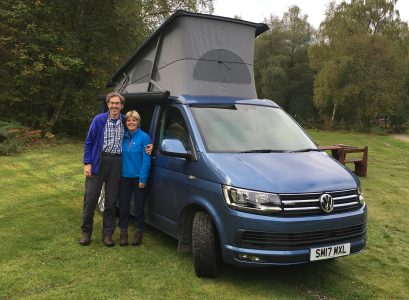
Eventually we headed on our way, and planned a coffee stop at Reydarfjordur, a small community along the next fjord northwards. We pulled into a lay-by just above the town to admire the view. Also parked in the lay-by was a red California, one of the few we have spotted on our journey around Iceland. The young couple came across to talk to us. They had just arrived on the ferry that morning, having spent a week on the Faroes. They were also planning spending a year travelling around Europe. The guy had fought in Afghanistan for the British Army, and lost a leg, so was taking this opportunity to travel. He had previously done an expedition to Greenland, trekking across the ice shelf. We spend quite a while chatting with them and comparing notes, and gave them some tips on good places to visit and stay whilst in Iceland. We have yet to meet a fellow California owner that we haven’t immediately bonded with – I suspect we all share a bit of an intrepid spirit.

After coffee, we continued on to Egilsstadir. Rather than head straight to Seydisfjordur, we decided on a slight excursion inland along Lake Logurinn. The whole route alongside the lake was lined with purple lupins, growing like weeds, but producing a profusion of colour. It turns out that these are not native plants – they are Alaskan lupins introduced in the 1800s. However, they serve a useful purpose, since they help re-vitalise eroded soil by fixing nitrogen and stabilising the soil. In addition, all along the lakeside, there has been a massive project of re-forestation. Throughout the whole trip, we have seen very few trees in Iceland. Previous generations had chopped all the native trees down for firewood and for boat and house building. The Icelanders are now starting to plant trees again, in an attempt to help soil erosion. So the fauna along this route was very different from anything we had seen on our travels around the island. The lake itself was a milky white colour, and, like Loch Ness, has become famous for sporadic sightings of a ‘Monster Worm’ seen swimming in the deep lake.

We came to a splendid looking turf-roofed house which had been home to Gunner Gunnerson, a famous Icelandic author. In the restaurant on site, they were offering a ‘cake buffet’, but neither of us fancied a mountain of cakes, so opted for a modest slice of banana bread instead.

We then re-traced our steps, through Eglisstadir and on to Seydisfjordur, crossing the high mountain pass Fjardarheidi, 620 metres above sea-level. Three weeks ago, when we had arrived in Iceland, we drove from the ferry in a snowstorm over this pass, which was white with thick snow. Today, on our return trip, the sun was shining, and the roads clear of snow. There was still plenty of the white stuff lying on the ground, but a considerable amount had melted in the few weeks since we had passed through. Seydisfjordur looked splendid as we drove down off the mountain, and into the town. Our ferry was sat there at the docks, in the shadow of the fjord. 

Tomorrow we board, and head back to Denmark, via the Faroes. It’s sad to think our time in Iceland is nearly at an end. It has been quite an amazing experience, and nothing can prepare you for the totally awesome scenery. Undoubtedly one of the highlights of our trip. I somehow doubt it can be matched, but I’m prepared to be proven wrong.

Day 145 Hofn to Faskrudsfjordur, East Fjords, Iceland.

Today has been quite spectacular. Words cannot describe the scenery east of Hofn, as we drove towards the East Fjords. We set off with myself driving, but the scenery was just so stunning, that it was really hard to make any real progress along the road. Every five minutes, I would screech to a halt beside the road to take a photo. The mountains looked dramatic in the subdued sunlight, which highlighted all the layers and different colours due to the growth of lichen. After an hour or so, Howard asked whether the photos might all look a little similar – ‘lots of rocks’ was I think his comment! This , of course, was code for ‘Stop taking all these photos, and just drive’. Eventually, he could take no more, and jumped in the driving seat, eager to reach our designated coffee stop before lunch time. We arrived at Djupivogur just after one. It was a pleasant fishing town, sitting at the entrance to Berufjordur, a long steep sided fjord. The town has a pretty harbour, and a museum, housed in a long red building overlooking the harbour. We sat at a table outside the Museum, and had our belated morning coffee in the sunshine.

We then continued on, driving along Berufjordur. We had not anticipated the 8km stretch of gravel road that we then encountered. We were driving on Route 1, Iceland’s main ring road – but suddenly the tarmac stopped, and we were met with a very stoney pot-holed stretch of road. The extraordinary thing was that just after the gravel finished, and the tarmac re-started again, someone had been along with spray paint to mark out the slight irregularities in the tarmac road. This was within two yards of where the exceedingly uneven and bumpy gravel road had stopped. The mind boggled. So, you are going to repair these tiny little imperfections in the tarmac road, after making us drive for 8km along a frankly despicable piece of gravel track!

However, we survived our bone shaking experience, and continued on along the northern flank of Berufjordur, to a fishing village called Breidalsvik. Nothing much seemed to go on here apart from fishing, so we continued to wind our way northwards, following the undulations of the fingers of fjords. All along the route, we saw purple lupins blooming at he side of the road, growing like weeds. For a relatively short distance, as the crow flies, it took us most of the day to reach Faskrudsfjordur, our stop off for tonight.

This is idyllic settlement, set in the most glorious steep sided fjord, lined with snowy mountains. We have treated ourselves to a night in a hotel, and, it is to die for! It sits right by the side of the fjord, and our room looks across the fjord to the mountains beyond. The town of Faskrudsdfjorsdur has a huge French influence. From the 16th century until World war 1, this fjord was host to the French fishing fleet. Approximately three hundred French fishing vessels operated out of this fjord, catching predominantly cod. Around Iceland there were a thousand French fishing boats at their peak, and as a result, a French Hospital ship serviced the fleet. When this ship sank, a French Hospital was sited in this fjord to tend to the French fisherman, and was actually sited in the hotel where we are currently staying. The French influence in Faskrudsdjordur remain, with all street names being in both Icelandic and French.

The town of Faskrudsjrdur is divine. It’s setting is sublime, looking out over the fjord, and the buildings are simple, but traditionally Icelandic, with brightly coloured wrought iron roofs. It has been a lovely place to spend our penultimate evening in Iceland. We started off in the Eastern Fjords, and this is where we have returned to – with it’s natural beauty and lack of mass tourism. Tomorrow we make our way along to Seydisfordur, where we will catch our ferry back to Denmark.

It has been a very special experience spending time here in Iceland. Nothing I can say will convey the sheer beauty of this country. Despite it’s wind and rain, it is an extraordinary place to visit. It hasn’t been without it’s trials, but has undoubtedly been one of the highlights of our trip to date.

Day 144 Reykjavik to Hofn, South Iceland.

Today we bade farewell to Thomas and Katy. The taxi came to pick them up at 5am, so Howard and I got an early start, which was just as well, since we had a long drive ahead of us.

The city was quiet as we left, and set off eastwards again along Route 1. This was the trip we had done a week earlier in the pouring rain, so it was good to see the scenery this time under better conditions. We decided to split the trip into four segments, so that we could switch over with the driving, and do a bit of sightseeing.

First stop was Selfoss for breakfast, at a cafe we had found with Thomas and Katy. Next stop was Vik. On the two previous occasions we had passed by here, the weather had been atrocious. However, today, contrary to the weather forecast, the sun came out. We headed down to the black sand beach, where you can see the famous rock stacks in the distance, known as the the Troll Rocks, and where previously you had been able to walk under the basalt cliffs and see a sea cave. Today, we found access to the beach cordoned off. Initially we had thought it was because the entire area is a nature reserve for puffins and other sea birds. But then we saw a notice saying that several people had died after being swept away by strong waves at the base of the basalt cliffs. So instead we followed the designated path along the cliff tops and admired the view. The wind was so strong, that at times it was hard to stand, but it blew away the cobwebs, and gave us a break from the driving. We also spotted the odd puffin or two peeking out from their burrows.

We then headed eastwards until we came to Skaftafell National Park, on the edge of the glacial ice cap. Our destination was a waterfall called Svartifoss. In order to reach it, we had to hike for about three kilometres, but the walk was worth it. Although not particularly high or broad, the Svartifoss waterfall plunges into a pool surrounded by an amphitheatre of hexagonal basalt columns, giving it the nickname the Black Falls. It was certainly an impressive sight as the sun glinted onto the basalt columns.

We continued on our way, to the last pit stop of our drive – another quick peek at Jokulsarlon, the glacial lagoon filled with icebergs. We had, of course, already visited here last week, but were unable to drive past again without a final look. The sun was strong, but lower in the sky than on our last visit, so the lagoon had taken on a very different appearance. Also, this time, the tide was coming in, causing the icebergs to move around the entrance to the lagoon, rather than flowing out into the sea. Once more, Howard and I just stood and stared – it is such a magical sight, and one which you could never get bored with.

Sadly though, by now it was getting late, so we tore ourselves away, and drove the final leg of our journey towards Hofn. We parked up, and headed straight to the Pizza Restaurant, where Howard treated himself to a ‘Lobster Festival’ – an interesting take on a pizza. 

We are now back on track to catch our ferry in a couple of days time. First we have the Eastern Fjords to explore, as we make our way back to Seydisfjordur. It’s hard to believe that we have been here in Iceland three weeks already. There’s so much we haven’t been able to see, but we have definitely fallen in love with the place. The scenery is just out of this world – very different from anywhere else we have ever visited. But if there’s one place in Iceland I would urge anyone to visit, it would be Jokulsarlon. Icebergs rock!

Days 140 – 143 Hvergerdi to Reykjavik

We have just spent a wonderful four days with Thomas and Katy. It was lovely to see them again, particularly so since this was the first time we had seen them since they got engaged. They had told us the news by Facetime some weeks ago, whilst we were sitting in St. Marks Square in Venice. It had seemed a very apt place to find out – such a romantic setting, and it had given us a good excuse to celebrate. So to meet them off the plane from Glasgow was especially exciting for us, and to welcome Katy into the family, so to speak.

The first two days of their trip we based ourselves out in the countryside, near Hekla. We hit the tourist trail, and did part of the Golden Circle with them, visiting Gulfoss waterfall and Geysir.  We also returned to the Seljalandsfoss waterfall. This time there was no chickening out – Howard, Thomas and Katy decided that they would walk behind the waterfall. I was put on photographic duty. So, kitted out in waterproofs, they took the narrow path behind the roaring waterfall. By all accounts it was a very wet experience, but they seemed to enjoy themselves.

Yesterday we headed off to the Reykajanes Peninsula, to visit one of the most popular tourist attractions in Iceland, the Blue Lagoon. Not seeing the great appeal of sitting in the effluent from a power station, I opted to watch from the side, whilst the three of them plunged themselves into the milky blue waters and cover their faces in mud. It was a hilarious sight, but I must say they embraced it with gusto.

Driving back to Reykjavik later that day, they all claimed that their skin felt softer, so maybe I should have joined in too. However, having ‘people-watched’ at the side of the lagoon, I was of the distinct opinion that there were bodies in there that I did not want to share my bath-time with!

We have spent the last day and a half in Reykjavik, the capital. It has happened to coincide with the Reykjavik Festival, so there has been plenty going on in the city, including parades, live music and a cycle race. Yesterday was a gorgeous evening, and we definitely saw the city at it’s best. The city’s landmark buildings, the Cathedral and the glass covered Concert Hall looked wonderful in the evening light. Today was cloudier, but dry nonetheless, and we had a lovely day just exploring the sights. One of the highlights for me was a visit to the Museum of Photography, which was hosting a splendid exhibition by a German photographer on photographs of the icy landscapes of Iceland and Greenland.

The highlight for Howard and Thomas was undoubtedly the ‘Saga Museum’, where they got to dress up as Vikings – such kids! That was closely followed by a visit to one of Reykjavik’s Microbreweries for a tasting of their ale. I made the error of trying one of their small batch gins. I hadn’t realised that it was ‘Navy strength’ – it was so strong I had to buy more tonic to make it vaguely drinkable.

So all in all, we have had a lovely time with the ‘children’. They leave early tomorrow morning, and then we have a very long drive eastwards, to get back on course for our ferry. It is hard to think that it is likely the next time we see them, they will be in Australia. But that is many months away, and before that, we have many other places to visit on our trip around Europe.

Day 139 Jokulsarlon to Hveragerdi, South Iceland.

After the excitement of yesterday, today seemed a bit of an anticlimax. We had had such a brilliant day in terms of weather and natural beauty, that it was always going to be hard to match.

After breakfast, we went and had one final ‘fix’ of the icebergs in the glacial lagoon. It was a cloudy morning, and so the light was a lot more subdued. Interestingly, the icebergs really do look bluer in this light. We parked in a slightly different area to yesterday, where the glacial lagoon empties out into the ocean. We watched the icebergs being pushed along by the raging torrent of water leaving the glacial pool, and slowly depositing them into the sea. The smaller ones just rushed along. The monsters often sat a while, shuffling position initially, before eventually being dragged headlong into the salty waters. It was quite mesmerising to watch. Howard took several videos, and decided that when we get back home, he will make a ‘Slow TV’ video with them.

The tongues of the glacier were still visible as we drove back along Route 1, but without the vibrant blue sky of yesterday. As we drove back towards Vik, the weather really closed in again. We laughed as we approached the town. The huge sea stacks, which we have previously witnessed in the snow, were yet again barely visible through the mist and rain. We opted not to bother walking out to see them, and went to buy supplies instead. I think we are destined not to see them!

Remarkably, within fifteen minutes of leaving Vik, the rain stopped and the sun came out. I had read that Vik, being the southernmost town in Iceland, is also the wettest – but this was ridiculous. We continued on to Skogarfoss, a spectacular waterfall, and decided to take a look. Unfortunately, so had a thousand other tourists! By now, the sky was bright blue, and the thundering waterfall looked magnificent. However, trying to take a decent photograph when there were tons of people stood at the base proved near impossible. I persuaded Howard to step out into the river on some stones, to try for a photo opportunity. He then proceeded to dance on a rock, Mick Jagger style – talk about drawing attention to yourself!

We moved on, and started to remember some of the scenery from our previous visit to Iceland. That had been for a few days in snowy November – so everything had looked white and frozen. Today, everything looked incredibly green, presumably due to all the rain.

We pulled up at another waterfall, one which we had visited previously, called Seljalandsfoss. Although not as impressive as Skogarfoss, this waterfall is one that the public, if so moved, can walk behind. On our previous winter visit, we had just parked up and been the only ones there. Today, like Skogarfoss, it was heaving with tourists, and we were charged a whopping £10 to park the van – total rip off. I guess being nearer to Reykjavik, we should expect to see more people. We have been truly spoilt so far round Iceland, with very few tourists, particularly in the North and East. Fast approaching June now, we are coming into the busy season, and we have found a noticeable difference in the past week.

We walked up to the waterfall, but sensibly decided against walking behind it – mainly because we have no means of drying out our clothes. We did, however, watch those foolish enough to do so – and they seemed to be having fun. With the sun shining, a beautiful rainbow formed at the base. Howard, yet again, posed on a grassy hummock for a photo. Yet again, he embarrassed me. This time, it was Saturday Night Fever moves!

I’m not quite sure what Thomas will make of his father when he arrives tomorrow. Currently more Ben Hur than when he left Scotland – he definitely needs a haircut. I suspect he’s also considerably more relaxed, although this new tendency to dance in public is a little worrying. We set off for the airport tomorrow to pick up our new ‘house guests’. We have saved Reykjavik and the attractions nearby to do with them, so there will be plenty to see. Since we will be ‘entertaining’, I anticipate that the blog will go on hold for a few days, but I will pick it up once Thomas and Katy are away.

In the meantime, spare a thought for the three of us, trying to guide John Travolta round the Golden Circle!

Day 138 Hofn to Jokulsarlon, South Iceland.

Today was all about icebergs and glaciers. We had caught a taster of the glacial lagoons yesterday in the gloom, but had been praying for fine weather today so that we could experience them in all their glory.

Last night, before going to sleep, Howard did a sun-dance. Seriously! We had made a gamble with the weather (along with some Icelandic forecasting), and chosen to drive the best part of the south coast of Iceland, through wind and rain, in order to catch the weather window that was predicted for today.

It paid off. Despite biblical rain overnight, we awoke to sunshine and barely any wind. The harbour in Hofn looked calm and serene compared with last night, with the water like a mill pond. We had a quick look around, to check that there were no more whale sightings to be had, then we were off. We drove back westwards towards Jokulsarlon and the glacial lagoons. This morning, the landscape was transformed compared with yesterday. Driving out of Hofn, we immediately caught sight of the enormous Vatnajokull glacier, with three huge tongues of ice extending out into the Hornafjorour coastal plain. It was an absolutely stunning sight, all the more amazing, because as we had driven past yesterday in the rain and mist, we had not seen anything of this. Equally, the huge mountains with their screes coming right down beside the road, had been obscured to us yesterday.

Glaciers in Iceland make up 10% of the total land mass, and this southern glacier, Vatnajokull, accounts for a whopping 8% of Iceland’s land mass. The precipitation and snowfall onto the glacier each year is four metres, but despite this, the glacier is slowly receding. At Jokulsarlon, the glacier has formed a lagoon, which empties out into the ocean. This has created the amazing phenomenon of icebergs being deposited out from the lagoon into the sea. The lagoon is tidal, and every day with the tide, huge chunks of ice can be seen flowing down the narrow outlet channel and into the surf. Some of these monsters then get washed back onto the black volcanic sands, and at low tide, the beach is smattered with icebergs. It is quite an amazing sight to behold. I had read about it and seen photographs of it, but to witness it first hand was just incredible.

Somehow, icebergs seem to bring out the kid in men. Grown men were picking the smaller ones up and throwing them, or clambering onto the larger stranded ones posing for photos. Mentioning no names, but someone I know couldn’t resist a photo opportunity, only trouble being he was left with a very wet bottom after sitting on one.

After wandering down the beach, we crossed over the road to the inner lagoon, where we had an appointment. We had booked a ride on an amphibious craft that launches itself into the lagoon, and cruises around the icebergs and up to the glacial edge.

The craft itself looks a little like the Duck Tours, like you see in Boston. Life jacketed up, we set off. You can’t imagine how thrilled I was to be doing this. Again, it was something I had read about years ago, and it was one of my dreams to actually do it. The guide told us about the glacier and the icebergs, explaining that the salt water in the lagoon was causing the bergs to slowly melt, and that at some point, most would somersault over, exposing their black bottoms where they had ground their way down the mountainside. They were all shapes and sizes, some with the vivid blue colouration, others more white and subdued. It was a brilliant way to spend an hour, and one which I will never forget. 

Back on dry land again, and warmed up by a coffee, we climbed up the scree slope by the lagoon, and sat and ate our packed lunch. We just sat, and stared. It was the most remarkable sight, and one which we both feel very privileged to witness. The sun was still shining, and the sky blue was reflecting a brilliant blue in the lagoon – just wonderful.

Eventually we dragged ourselves away, and headed back over the road to the beach. By this time, the tide had come in, and all the stranded icebergs were bobbing around on the waves, with just small fragments left littering the shore-line.

After a walk along the black volcanic sands, we headed on once more, back to the Fjallsarlon lagoon which we had visited yesterday. It was transformed in the sunshine. The ghostly visions of icebergs peering through the mist was now replaced with vibrant ice blues, and the glacier clearly seen beyond. It was much less crowded than yesterday, and walking around the still shoreline, we found ourselves alone, looking out over this amazing sight. I’m not sure how long we stood and stared, but it was hard to take your eyes off this magnificent vision. Just incredible.

Howard and I feel very privileged to have had the opportunity to visit this very special place. For me, it is one of the highlights of our trip to Iceland so far. I think it will be hard to surpass.

Tonight, we’re both exhausted and elated. My fingers are sore from pressing the shutter button too many times on my camera, but somehow I doubt that any of my images will be able to convey the absolute beauty of what we have seen today.

I texted my ‘photo girls’ earlier, who were raving about the heat wave in the UK. They didn’t seem taken with icebergs. Well – each to their own, but for me, this was one of the best days of our trip. It just leaves me to thank Howard profusely for that rather weird dance he did last night, and for my friend Sandra for huffing and puffing the sunshine our way! Good job all.


Day 137 Vik to Hofn, South Iceland.

The day started with no promise at all. We looked out of the window to see mist and rain, again. After breakfast, we resigned ourselves to a day of travelling, with the hope of better weather tomorrow. As we drove past Vik, the weather was so bad, that we didn’t even bother to stop. We had visited here some years ago, and it is renowned for it’s spectacular black ash beach and dramatic sea-stacks. But today, you could see none of it. The clouds were so low, that the mist was all pervading, and you could only see a few yards ahead.

As we drove along Route 1, we passed a couple of tour buses going in the other direction. In our van madness, we started giving the commentary that we imagined the courier might be giving. ‘On your right, is ..fog, and on your left is .. more fog and mist, oh, and of course, bucketfuls of rain.’ We started feeling really sorry for the poor souls who had paid good money to drive around all day in a coach, with zero visibility out of the windows. As we were amusing ourselves in this way, one of our friends from home tuned in to tell us that they were having a mini-heatwave in Scotland. Another What’s Apped to tell us that they were having the best summer for a decade. ‘Thanks guys!’, we thought.

We continued on our way. Past Vik, the scenery changed dramatically, and for fifty kilometres or so, we were driving through lava fields. The lava had become covered in a greenish yellow moss over the centuries, to give it a strange globular texture. It was like driving through Teletubbyland. At one point, we braved the rain, and got out of the van to read one of the information boards.

The board told us that the lava fields were the result of the eruption of the volcano Laki in 1783. It continued to spew lava for the next five months, eventually covering an area of 600 square kilometres. The volcanic ash and dust that resulted from the eruption spread to many other countries, causing climactic changes due to the fine ash particles and air pollution. Eastern European climate became cold and unstable, causing crop failures. Even countries as far afield as Japan and the USA were affected. Some speculate that the French Revolution in 1789 was largely triggered by the crop failures and famine that resulted from the eruption of Laki!

We continued east along Route 1, and came to the huge glacier fields. Having driven through driving rain for several hours, as we arrived the mist suddenly cleared, and we got our first glance of the glacier edge. A few miles further down the road, the rain stopped, the sky turned blue, and we got the most spectacular view of the advancing glacier extending down the mountainside. The weather window only lasted ten minutes or so, but was enough to whet our appetites.

Further along the road, we came to the Glacial Lagoon at Fjallsarlon. We climbed a ridge in the lava and peered into the lagoon. One solitary iceberg was silently floating in the lagoon, peering out of the mist. It looked just magical.

We moved along to the car park where many vehicles had gathered, and walked down to the path to the main lagoon. Hundreds of icebergs mingled in the gloom, some bright ice blue, some white, some greyish, and all shapes and sizes. What a picture!

Eventually the cold and rain drove us back to the van, and we moved on to Jokulsarlon, the place where the glacial lake meets the sea. Here, the lake is tidal, and the icebergs are much larger than in Fjallsarlon. We leapt out of Oscar and down the slope to see for ourselves. Words can’t describe the scene. Large blue monsters slowly floated on the tide around the lagoon. The misty weather gave them an etherial quality, and Howard and I stood for ages just taking in the scene.

We eventually dragged ourselves away, and off to Hofn, for our night’s accommodation. We passed the field perched on the hill as we drove into town, which served as the campsite. A couple of Big Whites were up there, battling the wind and rain. We continued on to our Guest House by the harbour.

On arrival – no-one was there to greet us. We phoned the number on the board. The lady was apologetic, and promised to be there in two minutes. She rushed in, excitedly. ‘There’s a Wally in the harbour!’, she cried. ‘A Wally?’, we responded. ‘Yes, a Wally!”, she repeated.

We walked out of the guesthouse, and looked the few yards to the harbour. And there it was – a huge great humpback whale, no more than twenty feet from us, cruising around the harbour. We could hardly believe our eyes. 

So that was our day. A day that started uninvitingly, and that ended in a truly magical fashion. Who would have guessed?

Day 136 Arnarstapi, Snaefellsnes Peninsula, West Iceland to Vik, South Iceland.

The rain continued to fall all night, and this morning, although the rain had abated temporarily, it was decidedly dreich. Last night, we checked out the Iceland meteorology website to see what the next few days of weather holds. The forecast was pretty dire in the south west and south, with a yellow weather warning of flooding for the Reykjavik area and it’s environs. We have four days to occupy before my eldest son Thomas and his fiancee fly out to meet us in Reykjavik for a few days. So we made the strategical decision to bypass Reykjavik and it’s atrocious weather, and head further east. This morning, we had a last wander along the bird cliffs at Arnarstapi, and had a look at the strange basalt sculpture of a mythical troll-like creature that dominates the headland at this point. 

Then we headed off the beautiful Snaefellsnes Peninsula, which yesterday had looked so appealing in the bright skies. Today, it had taken on a much more foreboding mood, with dark volcanic mountains and moss ridden lava fields. Rain poured off the mountain-sides, forming waterfalls in the gullies. The green moss on the scree seemed to stand out against an otherwise monochromatic landscape. Within minutes of setting off, the rain had returned, and the cloud so low that it was like driving in mist. We confirmed with ourselves that we had made the right decision last night to ‘cut and run’ with this part of Iceland.

On reaching Borgarnes, a junction where the peninsula road meets back up with Route 1, we stopped for coffee and provisions. The shop here was exceedingly well stocked for campers, and we idled several minutes looking to see if there was anything we might need. We opted for another bungee for the bike cover, and a strange tennis racket like implement, that apparently zaps flies and electrocutes them! I’ve never been partial to flies, and by all accounts, Scandinavia in the summer months is ridden with the buggers. On our visit to ‘Midge Lake’ in the North East of Iceland, we were fortunate (or not!) that the winds were so strong that they couldn’t fly. However, on one occasion the next day, we did open the van doors to find a swarm outside. With this ‘fly electrocution’ instrument, and our midge cagoules – we’ll be prepared!

The other thing that I have increasingly noticed in Iceland, is the Icelanders love of liquorice. It is everywhere. I first noticed it on the ferry boat here. In the Duty Free shop, they were selling bags of ‘Lakkris’ – sweets consisting of a liquorice centre, surrounded by caramel then chocolate. On arrival in Iceland, we then noticed all variation of ‘Lakkris’ –  some with cocoa powder dusting, some with white chocolate. I bought a packet, and have become strangely addicted to the things, much to Howard’s disgust. Then there are all the other liquorice products – liquorice salt, liquorice tea bags – in fact, all things liquorice. I am beginning to think that the Icelanders have a problem with chronic constipation maybe?!

The drive was quite long, and tedious in the rain. We alternated driving, me doing the quiet country roads, and Howard doing the ones with traffic. We eventually arrived in Vik, having booked into a cheap farmhouse guesthouse (Howard is disputing this comment!), not having the stamina for camping in these conditions. We were met by a gum chewing youth at reception. After directing us to the room in the low grey farm building, he asked us if we would like supper. Our eyes lit up. ‘Yes, that would be lovely’, we replied. ‘It’s just that our chef’s on holiday this week’, he retorted. ‘Aarrgh! Why offer then, you gormless gum chewing excuse for a receptionist’, I quietly thought to myself. No worries. The place is warm and dry, and we have just cooked omelette from our supplies in Oscar. The other bonus is hopefully the WiFi will work, and I can post the blog. Tomorrow, we’re hoping for less rain – Howard’s certainly trying hard with his ‘sun dance’! In the meantime – I’ll leave you with some more photos from Snaefellsnes, mostly taken yesterday.

Day 135 Stykkisholmer to Arnarstapi, Snaefellsnes Peninsula, West Iceland.

We had a brilliant day today driving around the Snaefellsnes Peninsula. We were treated to a lovely breakfast in the boutique hotel we had been upgraded to – it was truly delicious, with lots of local Icelandic products, like local smoked salmon and cheese, home-made smoothie and home made bread. I did feel slightly guilty though, that all the poor souls who were eating breakfast with us had paid the full price. The hotel itself was tiny, more like an old Icelandic house, with ten tiny bedrooms. The lounge /dining room was so small, that they had to offer breakfast in two sittings. We looked up the regular price for the rooms and it was astronomically expensive – hard to justify, we thought, even though it was lovely.

Last night in the fish restaurant where we ate, the couple on the table next to us were served large speckled boiled eggs and toast, as a second starter. In polite conversation with them, I commented that I hadn’t seen eggs on the menu. It turned out it was a ‘special’ of Seagull’s Eggs. I’m still wondering what they tasted like – very fishy I would imagine.

I diverge. Back to today. I was relieved to find that the route was on a metalled road all the way. Within minutes of leaving town, we were met with the most stunning scenery – towering snow-clad mountains, volcanoes and lava fields. The surface of the lava is a mixture of black pumice, covered with moss and vegetation, producing a green /brown tinge to the rocks. This morning the sun was shining, and the mountains looked amazing against the bright blue sky. After two hours, our progress was minimal, having only driven twenty miles or so, such was the temptation to stop and admire the vistas, and read the frequent information boards.

At one point we came to a beautiful fjord, Kolkgrafafjordur, and Howard read the board. We were told that between December 2012 and February 2013, 52,000 tons of herring – yes, that’s correct – 52,000 tons – had died in two separate catastrophic events. In the years preceding the herring mass mortality, the Icelandic population of spawning herring had started wintering in Breidafjordur Bay, by the fjord. In 2008, they reached peak numbers of 800 – 900 thousand tons. The day before the mass mortality, 300 thousand tons of herring were located in the fjord. The mass mortality was caused by lowered levels of oxygen concentration in the seawater, probably as a result of prolonged calm weather, and the high biomass of herring in the fjord.

We carried on along the peninsula road, and came to the town of Grundarfjordur, set in a dramatic bay, and dominated by the iconic mountain Kirkjufell on it’s western flank. This is one of the most photographed mountains in Iceland – it certainly looked impressive today, and I guess is the Icelandic equivalent of the Scottish Buachaille Etive Mor.

Moving on, we came to the Snaefellsjokull National Park, with it’s volcanoes, lava fields and the Snaefellsjokull Glacier. The scenery was dramatic, and very different. Odd lava tubes sprouted out from the lava boulder fields, giving the whole landscape an eerie feel. Indeed, Jules Verne based his novel ‘Journey to the Centre of the Earth’ on this bizarre landscape. We came to the Saxtoll volcano crater, which was responsible for much of the lava in this part of the park. We braved the cold wind and climbed up to the shattered caldera of this volcano, which gave magnificent views over the lava flows below. We got back to Oscar just as the rain clouds loomed, and within minutes, the rain had set in.

Further round the peninsula, we stopped briefly to observe the strange rock pillars formed  by glaciation effects on the lava, and cliffs home to thousands of nesting sea-birds. But by now, we had seen the best of the weather.

We ended our day in Arnarstapi, with its smattering of holiday cottages and a monument to Jules Verne.

It has been a day of wonderful scenery and unearthly landscapes – a very special place indeed. Our Danish friend had recommended that we visit this peninsula, off the main Ring Road route, and I am very glad we did. We were lucky to have a half decent day weather wise, also. For the next couple of days, heavy rain is forecast, so photographic opportunities may be severely limited.

Both Howard and I feel weary tonight – all these photo opportunities have exhausted us! Howard has started doing competitive photography – I’ve taught him too well – leading lines, rules of thirds, interesting foregrounds etc etc. At one point today, I found him skulking down a bank to use a stream as a leading line – sneaky, or what? I think all the requests for group photo shots earlier on our trip have just gone to his head. I even found him sporting my camera earlier today. I think I’ll need to have words!